
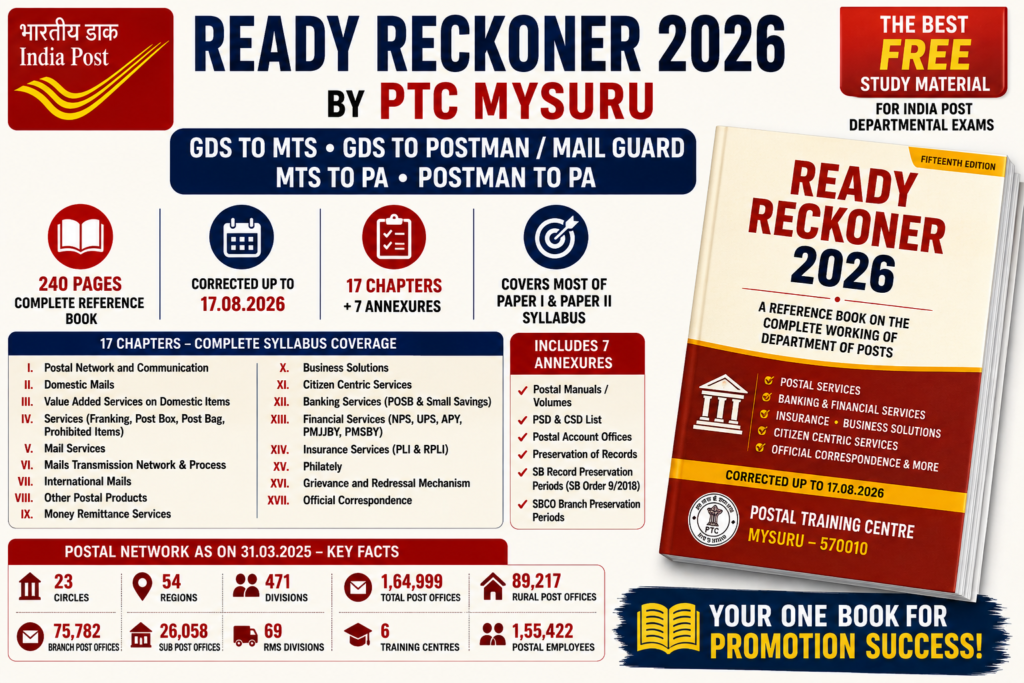
If you are preparing for the GDS to MTS, GDS to Postman / Mail Guard, MTS to PA or Postman to PA departmental exam, this one book covers most of your Paper I and Paper II syllabus.
The Ready Reckoner 2026, published by the Postal Training Centre (PTC), Mysuru, is a 240-page reference book on the complete working of the Department of Posts. It is corrected up to 17.08.2026, making it one of the most current study resources available to postal staff right now.
This post breaks down what is inside, which chapters matter most for your exam, and the key facts you should memorise straight away.
Book Details at a Glance
- Title: Ready Reckoner 2026
- Published by: Postal Training Centre, Mysuru – 570010
- Edition: Fifteenth Edition
- Total pages: 240 (239 numbered pages)
- Corrected up to: 17.08.2026
- Rights: Reserved with the Director, Postal Training Centre, Mysuru
- Structure: 17 chapters + 7 annexures
Important note from the preface: PTC Mysuru states the book is compiled in good faith but gives no warranty on completeness or accuracy. Aspirants are advised to verify information against the relevant rulings before acting on it. For exam purposes, always cross-check against the latest SB Orders and circulars.
Full Chapter List – What the Book Covers
| Chapter | Subject |
|---|---|
| I | Postal Network and Communication |
| II | Domestic Mails |
| III | Value Added Services on Domestic Items |
| IV | Services (Franking, Post Box, Post Bag, Prohibited Items) |
| V | Mail Services |
| VI | Mails Transmission Network & Process |
| VII | International Mails |
| VIII | Other Postal Products |
| IX | Money Remittance Services |
| X | Business Solutions |
| XI | Citizen Centric Services |
| XII | Banking Services (POSB & Small Savings) |
| XIII | Financial Services (NPS, UPS, APY, PMJJBY, PMSBY) |
| XIV | Insurance Services (PLI & RPLI) |
| XV | Philately |
| XVI | Grievance and Redressal Mechanism |
| XVII | Official Correspondence |
Annexures: Postal Manuals / Volumes, PSD & CSD list, Postal Account Offices, Preservation of Records, SB record preservation periods (SB Order 9/2018), and SBCO Branch preservation periods.
Which Chapters Matter Most for Your Exam
Not all 240 pages carry equal weight in departmental exams. Based on the usual LDCE pattern, prioritise like this:
High Priority – Study Thoroughly
- Chapter I – Postal network, milestones, Post Office Act 2023 (very high question frequency)
- Chapter XII – Banking Services and all small savings schemes
- Chapter XIV – PLI and RPLI, policy types and claim rules
- Chapter II & III – Domestic mails and value added services
- Chapter IX – Money orders, postal orders, eIPO
Medium Priority
- Chapter VI – RMS, PIN code, bagging and transmission
- Chapter XVI – Grievance redressal and complaint escalation
- Chapter XI – Citizen centric services (newer MoUs are current-affairs material)
- Chapter XIII – NPS, UPS, APY and the two Jan Suraksha schemes
Lower Priority – Skim Only
- Chapter VII – International mails (detailed tariffs rarely asked)
- Chapter XV – Philately (occasional one-mark questions)
- Annexures – Read once for awareness of record preservation periods
Postal Network as on 31.03.2025 – Memorise These Numbers
These figures appear repeatedly in India Post GK and departmental exam papers.
| Item | Number |
|---|---|
| Postal Circles | 23 |
| Postal Regions | 54 |
| Postal Divisions | 471 |
| Postal Accounts Offices | 23 |
| Circle Stamp Depot (CSD) | 1 |
| Postal Store Depots (PSD) | 26 |
| RMS Divisions | 69 |
| Postal Training Centres | 6 |
| Total Post Offices | 1,64,999 |
| Rural Post Offices | 1,49,385 |
| Urban Post Offices | 15,614 |
| Head Post Offices | 810 |
| Sub Post Offices | 24,281 |
| Branch Post Offices | 1,39,908 |
| Delivery Post Offices | 1,57,455 |
| Night Post Offices | 130 |
| National Sorting Hubs | 97 |
Coverage figures:
- Countries covered under International Speed Post (merchandise & documents): 100
- Countries covered (documents only): 6
- Average persons served per Post Office: 8,566
- Average rural persons per Rural Post Office: 6,083
- Average urban persons per Urban Post Office: 32,314
- Average area served by a Post Office: 19.92 sq. km.
Quick memory trick: 23 Circles, 54 Regions, 471 Divisions, 6 Training Centres. Post Offices are roughly 1.65 lakh, of which about 90% are rural and about 85% are Branch Post Offices.
Milestones in Indian Postal History – The Complete GK List
This table alone is worth printing out. Milestone questions appear in almost every India Post exam.
| Year / Date | Milestone |
|---|---|
| 1st Jul 1852 | Scinde Dawk — first adhesive postage stamp in Asia, issued in Sindh |
| 1854 | Indian Postal system came into existence |
| 1st Oct 1854 | First postage stamp for use throughout India |
| 1882 | Post Office Savings Bank opened |
| 1884 | Postal Life Insurance introduced |
| 18th Feb 1911 | World’s first airmail flight (Allahabad to Naini) |
| 1931 | First pictorial stamp used |
| 21st Nov 1947 | First postage stamps of independent India |
| 1954 | Post Office Centenary celebrated |
| 15th Aug 1972 | Postal Index Number (PIN) introduced |
| 1982 | Centenary of Post Office Savings Bank |
| 1st Aug 1986 | Speed Post introduced |
| 1994 | Express Parcel / VSAT money order service |
| 1995 | Rural Postal Life Insurance launched |
| 2003 | Meghdoot Software introduced |
| 2004 | India Post completed 150 years |
| 2006 | ePayment services introduced |
| 2008 | Project Arrow — modernization of Post Offices |
| 2010 | Mail Network Optimization Project |
| 2012 | IT Modernization Project commissioned |
| 17th May 2016 | DARPAN project pilot rollout |
| 31st Mar 2017 | First 2 IPPB pilot branches at Ranchi and Raipur |
| 18th Aug 2018 | Parcel Network Optimization Project (PNOP) |
| 1st Sep 2018 | India Post Payments Bank launched |
| 1st Dec 2018 | Internet Banking launched for POSB accounts |
| 15th Oct 2019 | DOP Mobile Banking launched |
| 1st Mar 2022 | Magazine Post launched |
| 18th May 2022 | NEFT / RTGS for POSB launched |
| 20th Oct 2022 | First dedicated parcel train (Surat to Narayanpur Anant, Bihar) under Joint Parcel Product |
| 20th Jan 2023 | Tarang Post (Sea Link RTN), Hazira to Ghogha, Gujarat |
| 24th Dec 2023 | Post Office Act, 2023 notified |
| 18th Jun 2024 | Post Office Act, 2023 came into effect |
| 16th Dec 2024 | Post Office Rules 2024 and Regulations 2024 came into effect |
| 4th Aug 2025 | Nationwide rollout of Advanced Postal Technology (APT) |
Most commonly confused pair: the Act was notified on 24.12.2023 but came into effect on 18.06.2024. Examiners love this distinction.
The Post Office Act 2023 – High-Priority Topic
This is the biggest legal change in India Post in over a century, and it is heavily tested.
- Replaces the colonial-era Indian Post Office Act, 1898
- Shifts India Post’s focus from basic mail delivery to citizen-centric services — banking, insurance and government scheme implementation
- Notified: 24.12.2023 | Effective: 18.06.2024
Key Provisions to Remember
- “Item” is defined as an indivisible article which the Post Office accepts for providing a service
- The Post Office shall provide such services as the Central Government prescribes
- The Post Office has the exclusive privilege of issuing postage stamps
- Power to make Rules lies with the Central Government
- Power to make Regulations is delegated to the Director General
The Post Office Rules 2024
- Came into effect from 16.12.2024
- Replaced the Indian Post Office Rules, 1933
- Simple and concise — contains only 19 rules
Exam tip: remember the split clearly — Rules are made by the Central Government, Regulations by the Director General. This is a classic one-mark question.
Banking Services – KYC and Small Savings Essentials
- The Prevention of Money Laundering Act (PMLA) came into force from 1st July 2005
- Amended on 01.06.2009, bringing the Department of Posts within its ambit as a “financial institution” under Section 2(1)(l)
- KYC became applicable to POSB and National Savings Scheme accounts from 01.06.2009
- Primary AML and KYC guidelines for small savings are governed by SB Order No. 12/2023 (Master Circular No. 2)
- Since 01.04.2016, interest rates on small savings schemes are reviewed and revised quarterly by the Ministry of Finance
Small Savings Schemes and Compounding Frequency
| Scheme | Compounding |
|---|---|
| Post Office Savings Account | Annually |
| National Savings Time Deposit (1, 2, 3, 5 year) | Quarterly |
| National Savings Recurring Deposit (5 year) | Quarterly |
| Senior Citizens Savings Scheme (5 year) | Quarterly paid |
| Monthly Income Account Scheme (5 year) | Monthly paid |
| National Savings Certificate (VIII Issue) | Annually |
| Public Provident Fund | Annually |
| Kisan Vikas Patra | Annually |
| Sukanya Samriddhi Account | Annually |
| Mahila Samman Savings Certificate | Quarterly |
Note: actual interest rates change every quarter. Always check the current Ministry of Finance notification rather than relying on any printed rate.
PLI and RPLI Policy Names – Easy Marks
Chapter XIV covers insurance in depth. The policy names are frequently asked:
Postal Life Insurance (PLI):
- Endowment Assurance — Santhosh
- Whole Life Assurance — Suraksha
- Convertible Whole Life Assurance — Suvidha
- Anticipated Endowment Assurance — Sumangal
- Joint Life Insurance — Yugal Suraksha
- Children Policy
Rural PLI (RPLI): Whole Life Assurance, Endowment Assurance, Convertible Whole Life Assurance, Anticipated Endowment Assurance, Grama Priya (10-year Rural PLI) and Children’s Policy.
The book also carries PLI bonus rates from 1984 to 2026 and RPLI bonus rates from 1996 to 2026 — useful reference, rarely asked in full.
How to Use This Book for Exam Preparation
A 240-page book cannot be read cover to cover in the last week. Use this method:
Step 1 – First Pass (1 week)
Read Chapters I, II, XII and XIV only. Highlight every number, date and defined term.
Step 2 – Make a Fact Sheet (3 days)
Copy all numbers, dates, scheme names and limits into a single 4-page sheet. This becomes your revision document — you will never open the full PDF again in the last month.
Step 3 – Link to Previous Year Papers
Solve previous year question papers for your exam, then trace each question back to its chapter. You will quickly see which 40 pages produce most of the questions.
Step 4 – Weekly Mock Tests
Attempt a full-length mock every week under real timing and on a real OMR sheet.
Step 5 – Monthly Update Check
The Ready Reckoner is corrected up to 17.08.2026. Anything after that date — new SB Orders, revised interest rates, fresh circulars — must be tracked separately from your circle’s website.
Remember: in most LDCE exams, Paper I and Paper II decide your merit rank, while Paper III and DEST are only qualifying. Put your Ready Reckoner study time where the marks actually count.
Where to Download the Ready Reckoner 2026 PDF
- Check the Postal Training Centre, Mysuru page and the training section on www.indiapost.gov.in
- Many Circle Offices and Divisional Offices circulate the PDF internally — ask your Divisional Office or Inspector
- Your RTC / PTC during induction or refresher training will have the latest edition
Always confirm you have the 2026 edition corrected up to 17.08.2026. Older editions carry outdated network figures, superseded SB Orders and pre-Post Office Act 2023 material that will cost you marks.
Frequently Asked Questions
Q. Is the Ready Reckoner enough for the GDS to MTS or MTS to Postman exam? It covers a large part of Paper I and Paper II, but not everything. Pair it with the Post Office Guides, relevant Postal Manuals and recent SB Orders, plus previous year question papers.
Q. Which edition should I study? Only the latest. This is the Fifteenth Edition, corrected up to 17.08.2026. Network figures and rules change every year.
Q. Can I rely on the interest rates printed in it? No. Small savings rates are revised quarterly by the Ministry of Finance. Verify current rates before your exam.
Q. Is it useful for Postal Assistant and Sorting Assistant exams too? Yes. The Banking, Insurance, Mails and Grievance chapters are directly relevant to PA/SA work and departmental exam syllabi.
Q. Who publishes it? The Postal Training Centre, Mysuru. All rights are reserved with the Director, PTC Mysuru.
Final Word
The Ready Reckoner 2026 is the closest thing India Post has to an official all-in-one study guide. 17 chapters, 240 pages, corrected to August 2026 — covering everything from the Post Office Act 2023 to Sukanya Samriddhi to PLI bonus rates.
Do not try to memorise all of it. Extract the numbers, dates and definitions from Chapters I, II, XII and XIV, build a fact sheet, and revise that sheet every week. That single habit is worth more than reading the whole book twice