
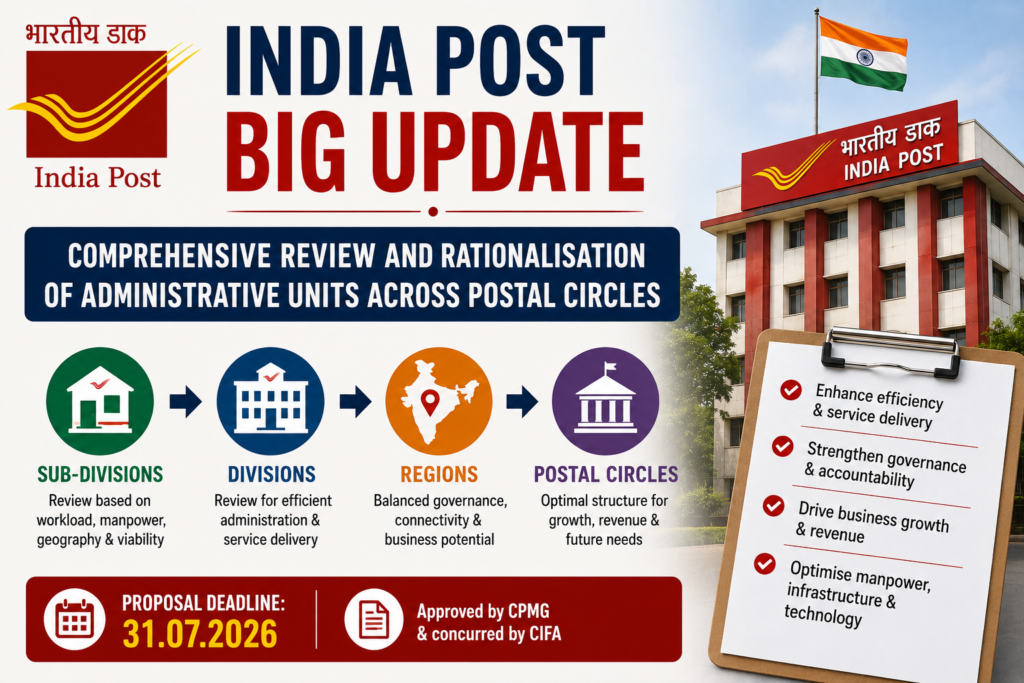
A major circular has been issued by the Department of Posts. This circular talks about reviewing and reorganising the entire administrative structure of India Post. This blog explains everything in simple words. This update is important for every postal employee and for GDS to MTS, MTS to PA, and Postman to PA aspirants who want to stay updated with India Post latest news.
What Is This Circular About?
The Department of Posts, Establishment Division, has issued a circular. This circular is numbered Y-38/2/2026-PE-II-DOP, dated 17th July 2026. It is addressed to All Heads of Postal Circles.
The subject of this circular is:
- Comprehensive Review and Rationalisation of Administrative Units across Postal Circles.
- The goal is to enhance Administrative Efficiency, Business Development, and Revenue Generation.
Why Is This Review Being Done?
The Department explains the background clearly:
- India Post is going through a big transformation. It wants to become customer-centric, technology-enabled, operationally efficient, and financially sustainable.
- In the last decade, India Post’s work has grown a lot. This includes e-commerce logistics, parcel services, digital products, financial inclusion, Direct Benefit Transfer (DBT), and other citizen-centric services.
- Technology upgrades like APT 2.0 and digitisation have changed how postal services work.
- However, the administrative structure at Circle, Regional, Divisional, and Sub-Divisional levels has not been reviewed properly for a long time.
- This has caused imbalance. Some units have become too big and hard to manage. Other units are under-used. This affects supervision, accountability, service delivery, and business growth.
Objectives of This Review
The Department has listed five main objectives for this review:
- To rationalise jurisdiction, workload, and supervisory span, and create balanced and viable administrative units.
- To strengthen governance, monitoring, accountability, and decentralised decision-making.
- To improve operational efficiency, service delivery, and responsiveness to customers.
- To enable business development, customer outreach, revenue growth, and financial sustainability.
- To optimise the deployment of manpower, infrastructure, and technology, keeping future needs in mind.
Scope of the Review
This review will cover four levels of the administrative hierarchy, in this order:
- Sub-Divisions
- Divisions
- Regions
- Postal Circles
The review will be based on evidence. It will consider SIU norms, workload, administrative span, operational viability, financial sustainability, business potential, and long-term feasibility.
Review Criteria for Sub-Divisions
Each Sub-Division will be reviewed under these heads:
- Workload and Scale: SIU norms, number of Sub Post Offices and Branch Post Offices (10-15 Sub Post Offices or 80 Branch Post Offices as indicative benchmarks), sanctioned strength, staff in position, population, geography, terrain
- Administrative and Governance Considerations: Span of supervision, reporting arrangements, inspection and monitoring needs
- Operational Considerations: Travel time, accessibility, transport, communication, and digital connectivity
- Financial and Business Considerations: Revenue, expenditure, Expenditure Coverage Ratio (ECR), cost implications, business potential
Review Criteria for Divisions
Each Postal Division will be reviewed on similar lines, with slightly bigger benchmarks:
- Indicative benchmark: 50 Sub Post Offices or 400 Branch Post Offices
- Same four heads apply: Workload and Scale, Administrative/Governance, Operational, and Financial/Business Considerations
Review Criteria for Regions
Regions will be reviewed based on:
- Number and distribution of Head Post Offices, Sub Post Offices, Branch Post Offices, Mail Offices, and other units
- Sanctioned strength and staff in position
- Population, geography, terrain, and contiguity
- Span of governance, coordination with State/UT Governments
- Travel time, connectivity, and financial/business factors
Review Criteria for Postal Circles
Each Postal Circle will examine whether its current jurisdiction is still appropriate. Key parameters include:
- Number of Regions, Postal Divisions, RMS Divisions, Sub-Divisions, Post Offices, Mail Offices, and employees
- Population, geographical area, districts, and States/UTs covered
- Geographical contiguity, terrain, and strategic considerations
- Governance span, coordination with State/UT Governments
- Financial and business factors, including ECR and future growth potential
Guiding Principles While Preparing Proposals
If any Circle proposes creation, merger, or reorganisation of a unit, it must follow these principles:
- Optimum Utilisation of Existing Infrastructure: Use existing land, buildings, and technology as much as possible. Avoid extra infrastructure spending.
- Manpower through Redeployment and Matching Savings: Staffing needs must be met by redeploying existing sanctioned posts. No new posts will be created in any cadre.
- Financial Viability: Every proposal must be financially sound, with minimum extra recurring cost.
How Should Circles Submit Proposals?
Every proposal must be submitted in a prescribed format, covering:
- Justification and Comparative Assessment: Comparison against SIU norms, jurisdictional maps, workload data
- Manpower and Implementation Plan: Cadre-wise staff strength, redeployment plan, confirmation of no new post creation
- Infrastructure and Operational Feasibility: Office space, equipment, connectivity, cost, and timeline
- Financial and Business Assessment: Cost-benefit analysis, impact on Establishment Cost Ratio (ECR), revenue projection for next 3 years
- Approvals and Supporting Documents: Recommendation by the Circle, approval of Chief Postmaster General, and concurrence of CIFA
Important Deadline
- The complete proposal, approved by the Chief Postmaster General and concurred by CIFA, must reach the Postal Directorate on or before 31.07.2026.
Templates Provided
To keep all proposals uniform, the Department has enclosed:
- A zip file with template user guide and draft format for Sub-Division
- A zip file with template user guide and draft format for Division
- A zip file with user guide, template, and draft format for Region
This circular is signed by Dushyant Mudgal, DDG (Establishment), with the approval of Secretary (Posts).
Quick Summary Table
| Point | Detail |
|---|---|
| Circular Number | Y-38/2/2026-PE-II-DOP |
| Date | 17.07.2026 |
| Subject | Comprehensive Review and Rationalisation of Administrative Units |
| Levels Covered | Sub-Divisions, Divisions, Regions, Postal Circles |
| Sub-Division Benchmark | 10-15 Sub Post Offices or 80 Branch Post Offices |
| Division Benchmark | 50 Sub Post Offices or 400 Branch Post Offices |
| New Posts | Not allowed; staffing via redeployment only |
| Proposal Deadline | 31.07.2026 |
| Issued By | Dushyant Mudgal, DDG (Establishment) |
Why This Update Matters for Departmental Exam Aspirants
If you are preparing for GDS to MTS exam, MTS to PA exam, Postman to PA exam, or any India Post departmental exam, here is why this matters:
- This kind of restructuring can affect the number and boundaries of Divisions, Sub-Divisions, and Regions in your Circle.
- It can influence future India Post recruitment and promotion patterns, since manpower is being redeployed rather than newly created.
- It is important India Post current affairs material, useful for general awareness sections of departmental exams.
- Staying updated on such structural changes helps you understand India Post’s direction as an organisation, which is useful background knowledge for interviews and descriptive questions too.
Final Words
The Department of Posts has started a major exercise to review and rebalance its entire administrative structure, from Sub-Divisions up to Postal Circles. This is aimed at making the organisation more efficient, financially sound, and better prepared for future growth. All Circles must submit their detailed proposals by 31.07.2026. Keep following updates on this topic, since it may shape the future structure of Divisions and Circles across the country.