
If you are a Gramin Dak Sevak (GDS) and have ever thought about leaving your post, this update is for you.
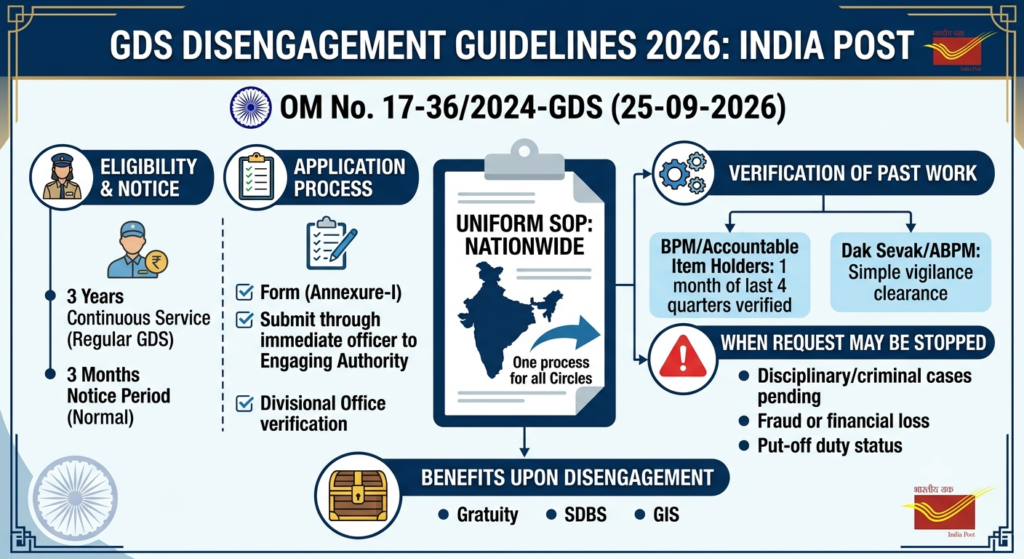
On 25 September 2026, the Department of Posts issued a new Office Memorandum (OM No. 17-36/2024-GDS) with clear guidelines on how a GDS can voluntarily disengage (leave) from service. Until now, different Circles handled these requests in different ways. This new SOP brings one uniform process for the whole country.
Let’s understand it in simple words.
Why Was This Circular Needed?
India Post was getting many queries about how GDS disengagement works. Some Circles verified past work one way, others did it differently. To remove this confusion, the department has now created one Standard Operating Procedure (SOP) along with a fixed application format (Annexure-I).
Important: The rules apply from the date of issue (25-09-2026) to all pending cases. Cases already settled will not be reopened.
Who Can Apply for Disengagement?
- A regular GDS who has completed 3 years of continuous engagement can apply.
- A notice period of 3 months is normally required.
- The Engaging Authority can accept a shorter notice if proper arrangements are made for the post.
- If you have not completed 3 years, you can still leave under Rule 8 of the GDS (Conduct and Engagement) Rules, 2020 by giving one month’s notice.
How to Apply
- Fill the application in the prescribed format (Annexure-I).
- Submit it to your Engaging Authority through your immediate controlling officer (SDH/SPM etc.).
- The Divisional Office will diarise it and do a first check.
Details you need to fill in the form:
- Name and GDS ID
- Office details (BO/SO/HO), Division and Circle
- Date of engagement and years of service
- Past service details
- Security bond details (if any)
- Any disciplinary or criminal case (pending or completed)
- Put-off duty status, if any
- Reason for disengagement
- Proposed date of relief
- Whether 3 months’ notice is covered
Verification of Past Work
Once you apply, your past work and conduct will be checked by the Sub-Divisional Head.
- For BPMs or GDS handling cash and accountable items: One full month from each of the last four quarters may be verified.
- For Dak Sevaks or ABPMs who did not handle money in the last four quarters: only a simple vigilance/conduct clearance is needed.
- Verification should be completed within one month. In special cases, the Divisional Head can give 15 more days.
When Can the Request Be Stopped?
Your request will not be accepted automatically if:
- Disciplinary proceedings are pending or planned against you
- You are on put-off duty
- There is any case of fraud, misappropriation, serious financial irregularity or loss to the Government
In such serious cases, the request will usually not be accepted until the matter is settled. In rare public-interest cases, it may go to the Regional DPS/PMG or CPMG level.
If your original educational, caste or antecedent verification is still pending, it will be completed on priority first. If any document is found fake, action will be taken as per law.
Working as Officiating MTS or Postman? Read This
Many GDS work on an officiating or deputation basis as MTS or Postman. As per the new rules, this arrangement will be ended first, and you will go back to your original GDS post. Only then will a decision be taken on your disengagement.
So if you are enjoying the MTS or Postman role, the smarter path is to get it permanently through the GDS to MTS Departmental Exam or the GDS to Postman Departmental Exam instead of leaving the department.
Acceptance Is Not the Same as Relief
This is a point many people miss:
- The decision (accepted or rejected) will be given to you in writing.
- Acceptance alone does not end your service.
- Your engagement ends only when you are formally relieved by the competent authority.
Can You Withdraw Your Request?
- Before acceptance: Yes, just give a written request.
- After acceptance but before relief: Usually allowed, unless there is a specific reason recorded in writing.
- After relief: No. Rejoining will not be allowed at all.
Before You Are Relieved
- Hand over all Government cash, records, registers, stamps, articles and devices.
- For BPMs, the Branch Office cash and records will be fully verified.
- Surrender your Identity Card and any departmental property.
- Any Government dues will be calculated and recovered as per rules.
- Your GDS ID will be deactivated immediately.
What Benefits Will You Get?
You will get benefits only as per existing rules under:
- GDS Gratuity
- Service Discharge Benefit Scheme (SDBS)
- GDS Group Insurance Scheme (GIS)
Disengagement does not give any extra benefit beyond these.
Quick Summary Table
| Point | Rule |
|---|---|
| Minimum service | 3 years continuous |
| Notice period | 3 months (1 month under Rule 8 if under 3 years) |
| Form | Annexure-I |
| Verification time | 1 month (+15 days if needed) |
| Withdrawal after relief | Not allowed |
| Benefits | Gratuity, SDBS, GIS as per rules |
Before You Decide to Leave, Think About Growth
Leaving is a big decision. Before you take it, remember that India Post gives GDS a clear path to grow through departmental exams:
- GDS to MTS – a regular departmental post with better salary and job security
- GDS to Postman/Mail Guard – another strong promotion route
- Later, MTS to PA and Postman to PA to become a Postal Assistant/Sorting Assistant
With the right GDS to MTS preparation, including the updated GDS to MTS syllabus, mock tests and previous year question papers, many GDS are clearing these exams every year. If your reason for leaving is salary or growth, a departmental promotion might be the better answer.
Stay connected with us for all India Post latest news, circulars and India Post departmental exam updates.