
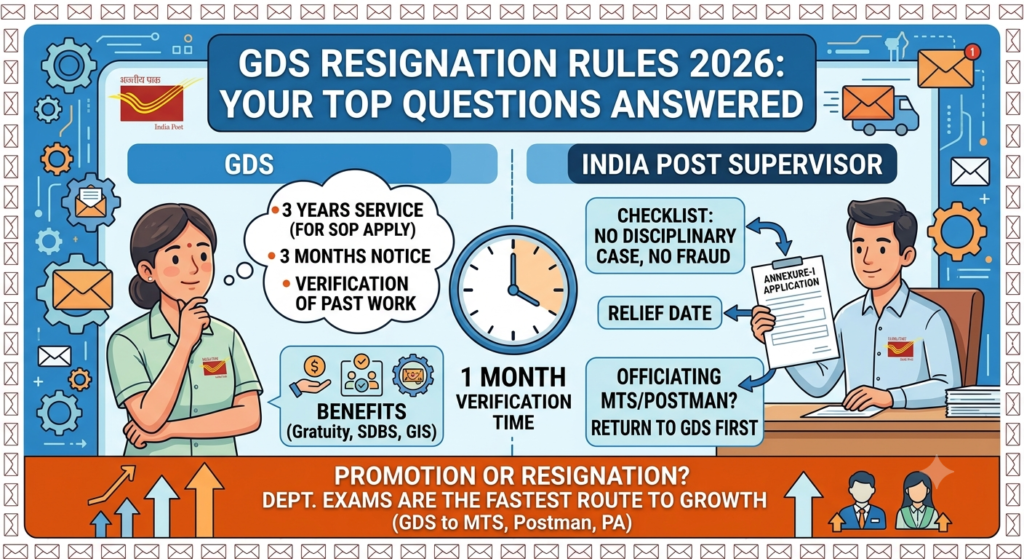
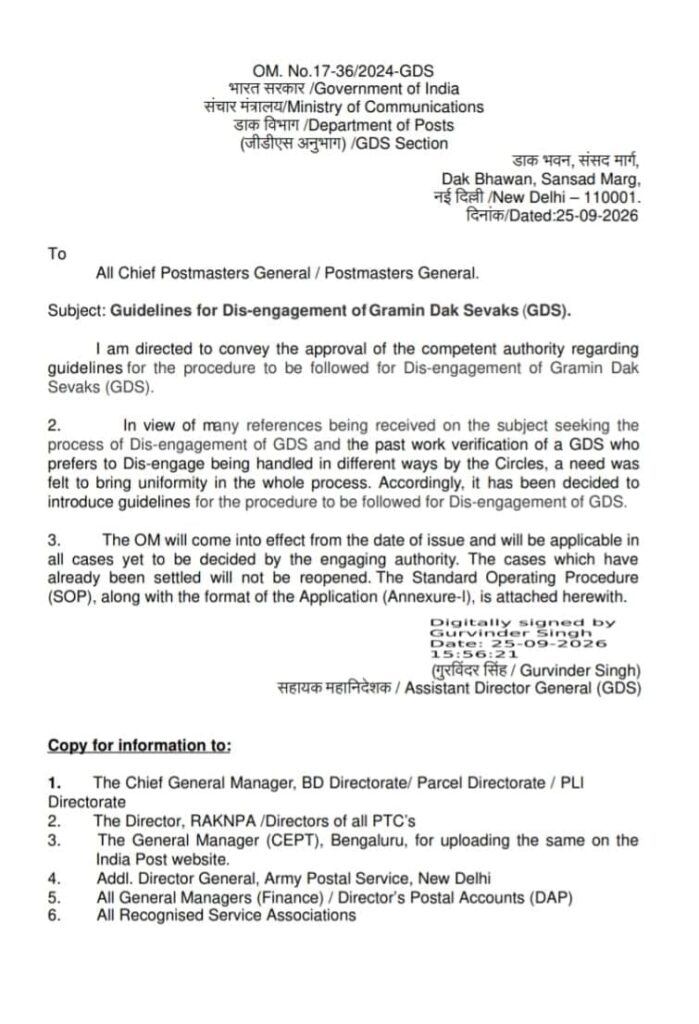
India Post has issued new guidelines on how a Gramin Dak Sevak can leave service (OM No. 17-36/2024-GDS, dated 25 September 2026). Since then, we’ve received many questions from GDS across the country.
Here are simple, straight answers to the most common ones.
(For the full breakdown of the SOP, read our detailed post: “GDS Disengagement Guidelines 2026”. Add the internal link here.)
1. What is “disengagement” of GDS?
It simply means a GDS voluntarily leaving their engagement, similar to resigning from a job.
2. Why did India Post issue these guidelines?
Different Circles were handling GDS resignations in different ways, especially the checking of past work. The new SOP brings one uniform process for the whole country.
3. From when do the new rules apply?
From 25 September 2026. They apply to all cases not yet decided. Cases already settled will not be reopened.
4. Who can apply under the new SOP?
A regular GDS who has completed 3 years of continuous engagement.
5. Can a GDS resign before completing 3 years?
Yes. Under Rule 8 of the GDS (Conduct and Engagement) Rules, 2020, a GDS can end the engagement by giving one month’s notice. The new SOP does not change this.
6. What is the notice period after 3 years?
Normally 3 months. The Engaging Authority can accept a shorter notice if proper arrangements for the post are made.
7. Where do I submit the application?
Fill the form in Annexure-I and submit it to your Engaging Authority through your immediate controlling officer (SDH/SPM).
8. What details are asked in the form?
Your name and GDS ID, office details, division and circle, date of engagement, years of service, security bond, any disciplinary or criminal case, put-off duty status, reason for leaving, proposed relief date, and whether 3 months’ notice is covered.
9. Will my past work be checked?
Yes.
- BPMs and GDS handling cash/accountable items: one full month from each of the last four quarters may be verified.
- Dak Sevaks/ABPMs not handling money: a simple vigilance/conduct clearance is enough.
10. How long does verification take?
Usually one month, with up to 15 extra days in special cases.
11. Can my request be rejected?
It will not be accepted automatically if disciplinary proceedings are pending, you are on put-off duty, or there is any case of fraud, misappropriation or loss to the Government.
12. I’m working as officiating MTS/Postman. What happens?
Your officiating arrangement will be ended first, and you’ll go back to your original GDS post before a decision is taken.
13. Can I withdraw my resignation?
- Before acceptance: Yes.
- After acceptance, before relief: Usually yes.
- After relief: No. Rejoining is not allowed.
14. Does acceptance mean I’m free to go?
No. Your engagement ends only when you are formally relieved after handing over charge, cash, records and your ID card.
15. What benefits will I get?
Only what the rules allow under GDS Gratuity, SDBS and GDS Group Insurance (GIS). Nothing extra is given for disengagement.
One Last Question: Should You Leave at All?
If you’re thinking of leaving because of low pay or no growth, pause for a moment. The GDS to MTS and GDS to Postman departmental exams can move you into a regular post with better salary, allowances and job security.
With the right GDS to MTS preparation, including the latest syllabus, previous year question papers and mock tests, your next step could be a promotion instead of a resignation.
Stay connected with us for every India Post latest news and circular update.