The Department of Posts has issued a fresh clarification on 2nd September 2026 about one of the most confusing topics in postal service — the meaning of the word “Station” in the Transfer Policy Guidelines.
If you are a Postal Assistant, Sorting Assistant, IP, ASP, Postman, MTS or GDS working anywhere in India Post, this circular affects your transfer. Read it once properly. It answers a question thousands of employees have been arguing about for years.
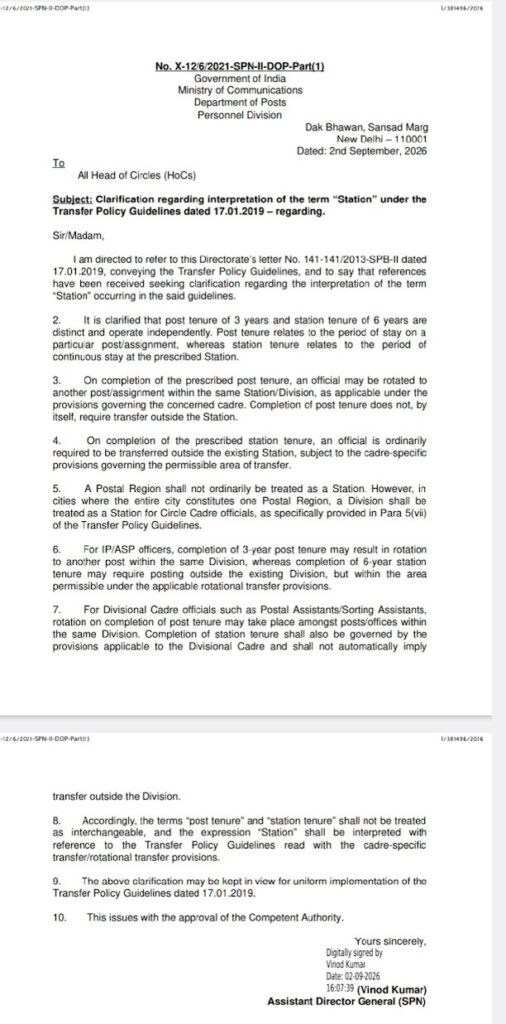
Basic Details of the Circular
| Detail | Information |
|---|---|
| Letter Number | No. X-12/6/2021-SPN-II-DOP-Part(1) |
| Issued By | Department of Posts, Personnel Division |
| Ministry | Ministry of Communications, Government of India |
| Address | Dak Bhawan, Sansad Marg, New Delhi – 110001 |
| Date | 2nd September, 2026 |
| Addressed To | All Head of Circles (HoCs) |
| Signed By | Vinod Kumar, Assistant Director General (SPN) |
| Subject | Clarification regarding interpretation of the term “Station” under the Transfer Policy Guidelines dated 17.01.2019 |
The original Transfer Policy Guidelines are from letter No. 141-141/2013-SPB-II dated 17.01.2019. Circles kept sending references asking what exactly “Station” means. This letter is the answer.
The Main Point in One Line
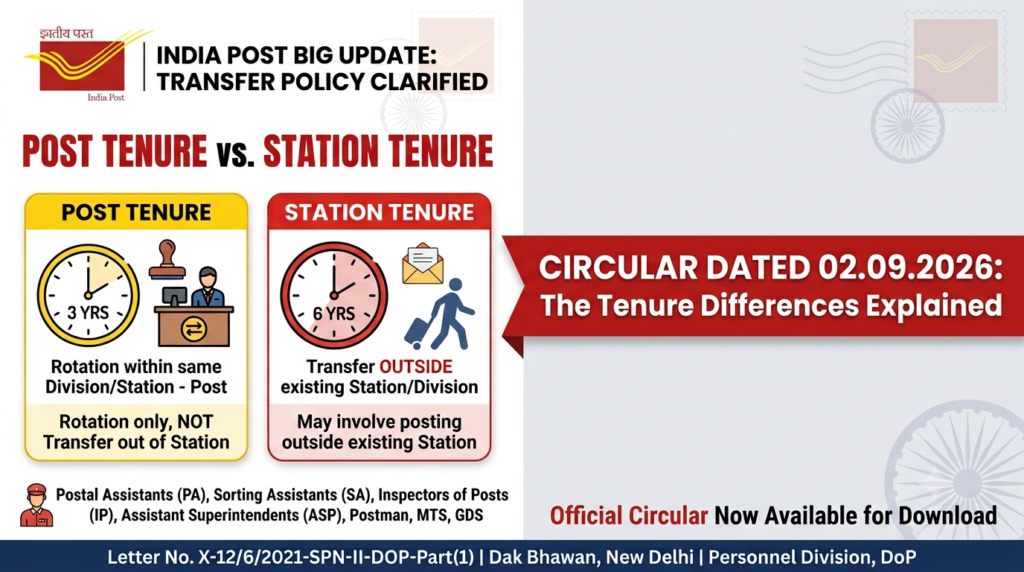
Post tenure and station tenure are two different things. They are not the same. They work independently of each other.
That is the whole circular in a single sentence. Now let us understand what it means in practice.
What is Post Tenure?
- Post tenure is 3 years
- It means the period you stay on one particular post or assignment
- Example: you are working as a PA at a particular counter or a particular office section
What happens when post tenure is over?
- You can be rotated to another post or assignment within the same Station or Division
- This depends on the rules of your own cadre
- Completing post tenure does NOT automatically mean you will be transferred out of your Station
This is the part most employees get wrong. Finishing 3 years on a post does not mean you are packing your bags for another city.
What is Station Tenure?
- Station tenure is 6 years
- It means the period of your continuous stay at the prescribed Station
What happens when station tenure is over?
- You are ordinarily required to be transferred outside the existing Station
- But this is still subject to your cadre-specific rules about the permissible area of transfer
So the 6-year clock is the one that can actually move you out. The 3-year clock only rotates you around.
Is a Postal Region a “Station”?
This is where a lot of confusion existed. The circular says clearly:
- A Postal Region shall NOT ordinarily be treated as a Station
- Exception: in cities where the entire city itself makes up one Postal Region, then a Division shall be treated as a Station for Circle Cadre officials
- This exception is already provided in Para 5(vii) of the Transfer Policy Guidelines
In simple words, a whole Region is too big to be called a Station. Only in special metro-type situations does the Division become the Station.
What This Means for IP / ASP Officers
The circular gives a separate example for IP and ASP officers:
- Completing 3-year post tenure → may be rotated to another post within the same Division
- Completing 6-year station tenure → may require posting outside the existing Division
- But even that outside posting must stay within the area permitted by the applicable rotational transfer provisions
So an IP/ASP finishing post tenure stays in the Division. Finishing station tenure is what can take them out of it.
What This Means for PA / SA (Divisional Cadre)
This is the part most readers of this blog will care about. For Divisional Cadre officials such as Postal Assistants and Sorting Assistants:
- On completion of post tenure, rotation may happen among posts or offices within the same Division
- On completion of station tenure, the matter is governed by the provisions applicable to the Divisional Cadre
- Very important: completing station tenure shall NOT automatically imply transfer outside the Division
Read that last line again. For PA and SA staff, station tenure ending does not by itself throw you out of your Division. Your Divisional Cadre rules decide what happens.
Quick Comparison Table
| Point | Post Tenure | Station Tenure |
|---|---|---|
| Period | 3 years | 6 years |
| What it counts | Stay on one post or assignment | Continuous stay at the Station |
| Normal result | Rotation within same Station / Division | Ordinarily transfer outside the Station |
| Automatic transfer out? | No | Depends on cadre rules |
| For PA / SA | Rotation within same Division | Not automatically outside the Division |
| For IP / ASP | Another post in same Division | May be posted outside the Division |
Final Instructions in the Circular
- The terms “post tenure” and “station tenure” shall not be treated as interchangeable
- The word “Station” must be read along with the Transfer Policy Guidelines and the cadre-specific transfer / rotational transfer provisions
- All Circles are asked to keep this in view for uniform implementation of the Transfer Policy Guidelines dated 17.01.2019
- The letter has been issued with the approval of the Competent Authority
The purpose is uniformity. Different Circles were interpreting “Station” in different ways, and staff in one Circle were being treated differently from staff in another. This letter is meant to stop that.
Why This Circular Matters to You
- If your Division was transferring people out just because 3 years were over, that practice is now clearly wrong
- If you are a PA or SA and were told station tenure means compulsory transfer outside the Division, that is also not correct as a blanket rule
- If you are filing a representation about a transfer, this circular is a strong document to attach
- Every Circle — Delhi, Punjab, Haryana, Rajasthan, Uttar Pradesh, Bihar, Madhya Pradesh, Maharashtra, Gujarat, Tamil Nadu, Karnataka, Kerala, Odisha, Assam and West Bengal — has to follow the same interpretation now
Keep a printed copy in your personal file. It costs nothing and it may help you one day.
Frequently Asked Questions
Q. My 3 years on this post are complete. Will I be transferred to another city? Not automatically. Completion of post tenure only means you can be rotated to another post within the same Station or Division.
Q. My 6 years at this Station are complete. Am I definitely going out? Ordinarily yes, you are required to be transferred outside the Station. But it is still subject to your cadre-specific rules about the permissible area of transfer.
Q. I am a Postal Assistant. Does station tenure mean I leave my Division? No. The circular clearly says it shall not automatically imply transfer outside the Division for Divisional Cadre officials.
Q. Is my Region my Station? No. A Postal Region is not ordinarily treated as a Station. Only where the entire city is one Postal Region does a Division become the Station for Circle Cadre officials.
Q. Which older order does this circular explain? The Transfer Policy Guidelines issued vide letter No. 141-141/2013-SPB-II dated 17.01.2019.
Q. Does this change the tenure periods? No. Post tenure remains 3 years and station tenure remains 6 years. Only the interpretation has been clarified.
Preparing for Your Next Promotion?
Understanding transfer rules is one part of postal service. Growing in your career is the other part.
If you are getting ready for a departmental promotion exam, these are the main routes:
- GDS to MTS Departmental Exam — full syllabus, exam pattern, eligibility criteria and selection process
- GDS to Postman / Mail Guard — previous year question papers and complete study material
- MTS to PA / SA Departmental Exam — mock tests, practice sets and question bank
- Postman to PA / SA Departmental Exam — question papers, syllabus and result updates
We publish India Post departmental exam updates, India Post circulars, India Post latest news, India Post previous year question papers, India Post study material, India Post mock tests, India Post GK and India Post current affairs in one place.
Looking for GDS to MTS online classes, GDS to MTS coaching, a complete GDS to MTS course, GDS to MTS live classes, GDS to MTS recorded classes, GDS to MTS study material or a GDS to MTS mock test series? We cover the entire GDS to MTS syllabus, GDS to MTS previous year question papers, GDS to MTS exam pattern and GDS to MTS eligibility in simple language.
We also track GDS to MTS notification 2026, GDS to MTS admit card, GDS to MTS result 2026, GDS to MTS exam date 2026, MTS to PA notification 2026, Postman to PA syllabus 2026 and Postal Assistant recruitment updates circle by circle.
Final Words
Transfer rules decide where you live, where your children study, and how far you travel every day. They deserve to be understood properly and applied the same way everywhere.
This circular does not give anyone a new right. It simply says: stop mixing up two different clocks. Three years is about your post. Six years is about your Station. Keep them separate.
Save this page. Share it with your colleagues in your Division. Somebody in your office is definitely confused about this right now.