
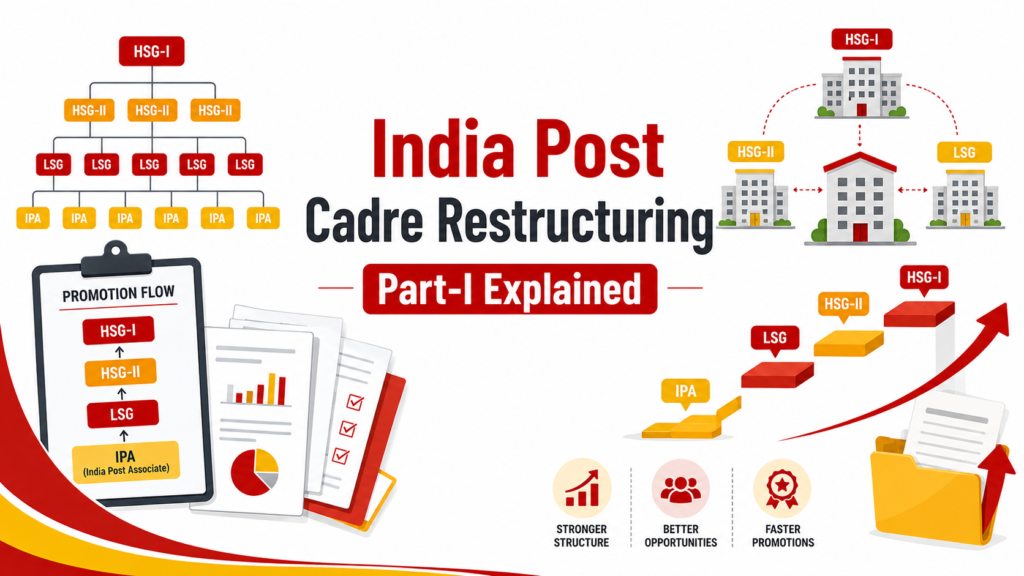
India Post Cadre Restructuring 2025 Part-I | Big Update for GDS to MTS & Postman to PA Aspirants Full simple summary of the India Post Cadre Restructuring Part-I report — PA/SA merger, 1,565 upgraded posts, new 1:3:9:27 ratio and what it means for GDS to MTS Departmental Exam, MTS to PA and Postman to PA candidates. Focus Keyword: India Post Departmental Exam URL Slug: india-post-cadre-restructuring-part-1-gds-to-mts-update
Quick Summary in 30 Seconds
The Department of Posts has released Part-I of the Cadre Restructuring Report for PA/SA, LSG, HSG-II and HSG-I posts.
Here is the short version:
- Postal Assistant (PA) and Sorting Assistant (SA) cadres will be merged into one single cadre.
- The new unified cadre name suggested is India Post Associate (IPA).
- Around 1,565 posts will be upgraded from Time Scale to Supervisory Grades.
- Supervisory strength will rise to 31.58% of the total cadre.
- No extra financial burden on the Department, because most staff already draw higher pay under MACP.
If you are preparing for the GDS to MTS Departmental Exam, MTS to PA, Postman to PA or GDS to Postman exam, this report directly affects your future promotion chain. Read the full breakdown below.
Who Made This Report?
The Committee was formed by the Directorate and later reconstituted. Its members are:
| Role | Officer |
|---|---|
| Chairperson | Shri K. Prakash, Chief Postmaster General, Karnataka Circle |
| Member-I | Shri G. Natarajan, Postmaster General, Chennai City Region, Tamil Nadu Circle |
| Member-II | Ms. Kaiya Arora, Director Postal Services, Mumbai Region, Maharashtra Circle |
Important dates:
- Committee formed: 03.06.2025
- Reconstituted: 15.07.2025
- Terms of Reference revised: 21.08.2025 (scope widened to include Post Offices, not just RMS and CO/RO)
Why Was Cadre Restructuring Needed?
The report explains the problem in very plain terms.
- The V. P. Singh Committee (2014) found that 87% of staff were in operative grades and only 13% in supervisory grades. It suggested a 65:35 ratio.
- Based on that, restructuring was done for Postal Assistants in 2016.
- But the same benefit could not reach RMS, SBCO and CO/RO because the Department of Expenditure asked for detailed functional justification.
- Result: RMS and Circle/Regional Office staff kept waiting. Their promotions became very slow.
The stagnation problem in numbers:
- Officials often spend over 20 years before reaching LSG.
- Many retire before even becoming eligible for HSG-II.
- Over 75% of HSG-I posts in RMS and CO/RO are lying vacant.
- Nearly 40% of those posts have been vacant for more than five years.
- MACP gave money, but not real promotion — officials draw higher pay while doing base-grade work.
This is exactly why candidates preparing through India Post Departmental Exam Coaching should track this report closely. Promotion speed decides your entire career timeline.
Main Recommendation 1: PA and SA Cadres Will Merge
The Committee has recommended:
- Merge Postal Assistant (PA) and Sorting Assistant (SA) entry grades first.
- Then merge the supervisory grades — LSG, HSG-II and HSG-I — after the new posts are filled.
- Give the merged cadre a common name: India Post Associate.
- Allow Rule-38 transfers immediately between PA (PO), SA and PA (CO/RO) at entry level, as a pre-merger transition step.
Why this matters to you: the promotion pool becomes bigger and common. A single seniority list means fairer and faster movement for everyone, whether you enter through Postal side, RMS or Circle Office.
Main Recommendation 2: 1,565 Posts Upgraded
The Committee recommends raising supervisory posts in Circle and Regional Offices to 16.66% of their existing strength.
- Total upgraded posts: 1,565
- RMS share: 1,404 posts
- CO/RO share: 161 posts
- Rule applied: one supervisory post for every six clerical posts in RMS and CO/RO
- Postal side: status quo maintained (already balanced at 34.84%)
Financial point: The report clearly states that creating these 1,565 posts will not impose any extra financial burden, because the expenditure is already being incurred through MACP financial upgradations.
Main Recommendation 3: The New Promotion Pyramid
This is the most important table for exam aspirants.
Proposed ratio → HSG-I : HSG-II : LSG : IPA = 1 : 3 : 9 : 27
Before Restructuring & Merger
| Grade | Admin | RMS | Postal | Total |
|---|---|---|---|---|
| HSG-I | 65 | 409 | 2,358 | 2,832 |
| HSG-II | 74 | 393 | 8,579 | 9,046 |
| LSG | 260 | 1,148 | 26,494 | 27,902 |
| PA/SA | 2,965 | 18,182 | 69,996 | 91,143 |
| Total | 3,364 | 20,132 | 1,07,427 | 1,30,923 |
Supervisory percentage before: 30.38%
After Restructuring & Merger
| Grade | Admin | RMS | Postal | Total |
|---|---|---|---|---|
| HSG-I | 43 | 258 | 2,879 | 3,180 |
| HSG-II | 129 | 774 | 8,637 | 9,540 |
| LSG | 388 | 2,322 | 25,911 | 28,621 |
| PA/SA | 2,804 | 16,778 | 69,999 | 89,581 |
| Total | 3,364 | 20,132 | 1,07,427 | 1,30,923 |
Supervisory percentage after: 31.58%
Also recommended:
- 25% of HSG-I posts to be marked as HSG-I Non-Functional Grade (NFG). A proposal will go to DoPT.
- 20–30% of LSG posts to be designated as LSG-SIPAs (Senior India Post Associates).
Main Recommendation 4: How Promotions Will Be Filled
The Committee suggests a three-stage process.
Stage 1
- The 1,565 upgraded posts to be filled first from existing RMS (1,404) and CO/RO (161) officials, to bring them at par with Postal side counterparts.
- After that, all vacancies flow through the unified chain: IPA → LSG → HSG-II → HSG-I.
Stage 2
- Unfilled HSG-I posts may be temporarily downgraded to HSG-II, and HSG-II to LSG, so promotions can happen from feeder grades. They get auto-upgraded later at the time of actual promotion.
- A one-time relaxation of eligibility service to 50% is proposed — meaning only 3 years service needed for both HSG-II and HSG-I.
Stage 3
- If posts still remain vacant, they may be adjusted against available IPA vacancies, exactly as was done during the Postal side restructuring.
Main Recommendation 5: New Work Norms
Supervisory posts in India Post are never 100% supervision. The report fixes a clear mix:
| Grade | Operational Work | Supervisory Work |
|---|---|---|
| HSG-I | 25% | 75% |
| HSG-II | 50% | 50% |
| LSG | 75% | 25% |
| Time Scale | 100% | 0% |
Recruitment and Training Changes
- Recruitment Rules will be revised for a single point of entry into the unified India Post Associate cadre.
- New recruits will get a common foundation course, then role-specific refresher training at Workplace Training Centres (WTCs).
- Serving officials moving between Post Office, RMS and Circle Office will get a targeted refresher course at PTC or WTC.
- ADP, SDP and SSDP training programmes will follow a unified syllabus.
What This Means for GDS to MTS and Other Departmental Exam Aspirants
Let us keep this practical.
- GDS to MTS aspirants: Your promotion ladder after MTS becomes clearer. A bigger LSG pool means the chain above you moves faster.
- MTS to PA aspirants: You will now be entering a merged cadre. More supervisory posts means shorter waiting time for LSG.
- Postman to PA aspirants: Same benefit. The unified cadre removes the old Postal vs RMS disadvantage.
- GDS to Postman / Mail Guard aspirants: Cross-cadre mobility under Rule-38 will make transfers and future growth easier.
The message is simple — the department is opening more promotion doors. The only thing standing between you and that door is the departmental exam itself.
How to Prepare Smartly
Whatever your target — GDS to MTS Departmental Exam, MTS to PA, Postman to PA or Postal Assistant (PA/SA) — the preparation method stays the same:
- Read the syllabus first. Download the official GDS to MTS Syllabus PDF and mark topic weightage.
- Solve previous year papers. GDS to MTS Previous Year Question Papers and India Post Previous Year Question Papers show the exact repeating pattern.
- Take regular mock tests. GDS to MTS Mock Test and India Post Mock Tests build speed and accuracy.
- Join structured classes. GDS to MTS Online Classes, live plus recorded, save you from random YouTube confusion.
- Practise daily. A fixed GDS to MTS Practice Set habit beats long unplanned study hours.
- Track notifications. Keep checking GDS to MTS Notification, exam date, admit card and result updates for your circle.
Aspirants from Rajasthan Circle, Uttar Pradesh Circle, Bihar Circle, Madhya Pradesh Circle, Maharashtra Circle, Gujarat Circle, Punjab Circle, Haryana Circle, Delhi Circle, Karnataka Circle, Tamil Nadu Circle, Kerala Circle, Odisha Circle, Assam Circle and West Bengal Circle can follow the same plan, since the departmental exam pattern is largely common.
Frequently Asked Questions
Q1. Is the PA/SA merger final? No. Part-I is a recommendation report by the Committee. Final approval will come from the Directorate, DoPT and Department of Expenditure.
Q2. What is the new cadre name? The Committee has suggested India Post Associate (IPA) for the unified cadre.
Q3. How many posts are being upgraded? 1,565 posts — 1,404 in RMS and 161 in CO/RO.
Q4. Will the Postal side lose anything? No. The report says status quo is maintained for the Postal side, which already has 34.84% supervisory posts.
Q5. Does this affect the GDS to MTS exam syllabus? Not directly. The syllabus stays as notified. But it improves your promotion prospects after you clear the exam.
Q6. Will this cost the government extra money? The report states it will not impose any extra financial burden, since most officials already draw supervisory-level pay through MACP.
Final Word
This report is one of the biggest structural updates India Post has seen in years. Cadre merger, 1,565 upgraded posts, a proper 1:3:9:27 pyramid and a one-time relaxation in eligibility service — all of it points in one direction: faster promotions for those who are inside the system.
So the real question is not whether promotions will improve. The question is whether you will be there to take them.
Start your preparation today.