
Published on: 11 August 2026 | Category: India Post Circulars, India Post Latest News, Departmental Promotion
Quick Summary (Read This First)
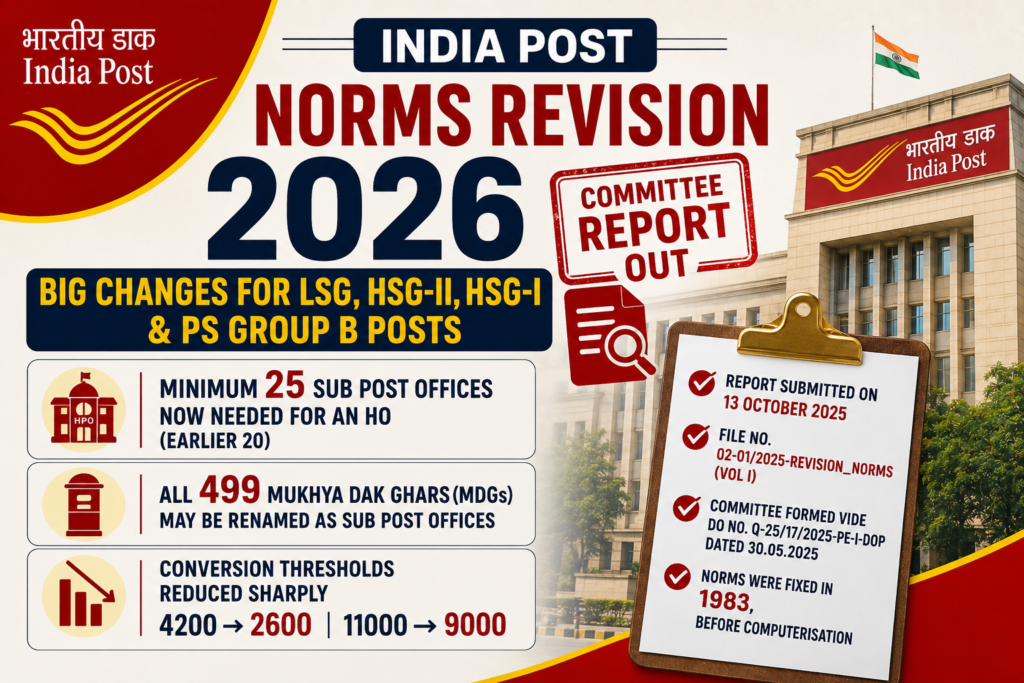
The Department of Posts has received the report of the Committee on Revision of Norms for converting a Sub Post Office into a Head Post Office, and for creating Postmaster posts in Group ‘A’ and Group ‘B’ Head Post Offices.
Here are the main points in one place:
- Report submitted on: 13 October 2025, from Bhubaneswar
- File No.: 02-01/2025-Revision_Norms (Vol I)
- Committee formed vide: Directorate Order No. Q-25/17/2025-PE-I-DOP dated 30.05.2025
- Chairman: Nirmaljit Singh, Chief Postmaster General, Odisha Circle
- Why it matters: the existing norms were fixed way back in 1983, before computerisation
- Biggest change: minimum 25 Sub Post Offices now needed for an HO (earlier 20)
- Second biggest change: all 499 Mukhya Dak Ghars (MDGs) may be renamed as Sub Post Offices
- Third: conversion point thresholds have been reduced sharply — 4200 points cut to 2600, and 11000 cut to 9000
If you are working as an LSG, HSG-II, HSG-I, PS Group ‘B’ officer, or preparing for India Post departmental promotion exams, this report directly affects your future posting and promotion chances. Read the full breakdown below.
Who Was on the Committee?
| Name | Designation | Role |
|---|---|---|
| Sh. Nirmaljit Singh | CPMG, Odisha Circle | Chairman |
| Ms. V. Tara | DPS HQ Region, Karnataka Circle | Member |
| Ms. Prabha Sharma | ADG (PE-I), Postal Directorate | Member |
| Sh. T. Rama Sudhakara Rao | AD (Estt. & Plg.), O/o CPMG Karnataka | Member & Convener |
| Sh. Bharata Kumar Patro | AD (E&P), O/o CPMG Odisha | Co-opted Member |
Terms of Reference: study the existing HPO norms and suggest amendments, keeping in mind all the changes that have happened since the old norms were framed.
Why New Norms Were Needed (Simple Explanation)
This is the heart of the whole report.
- The old norms were prescribed in 1983. At that time, no post office was computerised.
- Today, every category of post office is fully computerised — right down to the Branch Post Office level.
- Online transactions now happen everywhere.
- Back-end verticals like the Claims Settlement Branch, CPC for PLI/RPLI, and Accounts Branch are also fully computerised.
- New services have arrived that simply did not exist in 1983 — CBS, IPPB, POSPK, DGNK, Aadhaar Updation Centres, Delivery Centres.
- Separate Delivery Centres are being set up by splitting delivery branches out of urban post offices.
In short, the work has changed completely, but the yardstick to measure that work was 40+ years old.
Current Network Size (As Noted by the Committee)
- 469+ postal divisions across India
- 810 Head Post Offices
- 24,286 Sub Post Offices
- 499 Mukhya Dak Ghars (MDGs)
- Raipur HO (Chhattisgarh Circle) has 75 SOs attached to it
- BHEL HO (MP Circle), Chennai GPO, Anna Road HO (Tamil Nadu Circle) and Kolkata GPO (West Bengal Circle) have no SOs attached
This wide gap is exactly why a uniform rule was needed.
How the Committee Did Its Study
The Committee did not work only on paper. It carried out a sample work study from 21.08.2025 to 26.08.2025 at six real offices:
| Office | Type | SOs Attached |
|---|---|---|
| Bengaluru GPO | Group ‘A’ HO | 23 |
| Basavanagudi HPO | Group ‘B’ HO | 29 |
| Rajajinagar HPO | Group ‘B’ HO | 34 |
| Bhubaneswar GPO | Group ‘B’ HO | 56 |
| Dharwad HPO | Non-Gazetted HO | 18 |
| Vijayapura HO | Non-Gazetted HO | — |
Each office was measured under both the old norms and the proposed new norms, and the difference was tabulated. Those calculation sheets are attached as an Appendix to the report.
Recommendation 1: New Norms for Making a Sub Post Office into a Head Post Office
This is the change most employees are talking about.
- A Sub Post Office (not less than LSG grade) can be converted into a Head Post Office if a minimum of 25 Sub Post Offices can be attached to it. Earlier this figure was 20.
- Existing HOs or GPOs with HSG-I / PS Group B / JTS grade that have fewer than 25 or 20 SOs may maintain status quo — meaning they are protected.
- For backward areas, a lower standard can still be adopted with Directorate approval.
- The rule that every district should have a Head Post Office at the District Headquarters will continue — but now with the minimum of 25 SOs.
- All HOs must be at least HSG-I and above. Existing HSG-II HOs with 20 or more SOs may be upgraded to HSG-I level under the Matching Savings Scheme.
- HOs (other than those headed by HSG-I / PS Group B / JTS) having fewer than 20 SOs may be downgraded to Sub Post Office level, subject to justification and Directorate approval.
Recommendation 2: Bifurcation of an Existing Head Post Office
- An HO should be bifurcated if the number of SOs attached exceeds 60.
- After bifurcation, neither the new nor the old HO should have fewer than 25 SOs.
Recommendation 3: New Supervisor Structure — Very Important for Promotions
This table decides how many LSG, HSG-II and HSG-I posts will exist in an HO. Read it carefully.
| No. of SOs Attached | Level / Status of the HO | Other Supervisors |
|---|---|---|
| Up to 50 | HSG-I (Non-Gazetted) | 10 posts → 2 HSG-II + 8 LSG |
| 51–60 | PS Group ‘B’ (Gazetted) | 16 posts → 2 HSG-I + 4 HSG-II + 10 LSG |
| 61 and above | The HO may be bifurcated | — |
| 61 and above (if bifurcation not possible for administrative reasons) | HO may be upgraded to Group ‘A’ Level (JTS) | 1 PS Group ‘B’ as Dy. PM + 24 posts → 3 HSG-I + 6 HSG-II + 15 LSG |
What this means for you: a clear, written entitlement of supervisory posts at each HO size. That directly affects how many LSG and HSG vacancies open up in your division.
Recommendation 4: MDGs May Become Sub Post Offices
- The concept of Mukhya Dak Ghar (MDG) came from Directorate letter no. 14-21/2001-PE-I dated 21.01.2002.
- The Committee says this concept has now become redundant, because all customer services were extended right up to Branch Post Office level vide SB Order No. 27/2020 dated 23.07.2020.
- Therefore, all 499 MDGs in the country may be renamed as “Sub Post Offices” with the status of HSG-I / HSG-II / LSG, to keep uniformity across India.
- The circle-wise list of all 499 MDGs is enclosed as Annexure-I to the report. It covers Andhra Pradesh, Assam, Bihar, Chhattisgarh, Gujarat, Haryana, J&K, Jharkhand, Karnataka, Kerala, MP, Maharashtra, North East, Odisha, Punjab, Rajasthan, Tamil Nadu, Telangana, UP, Uttarakhand and West Bengal.
Recommendation 5: SBCO to Move Under the Divisional Superintendent
- The PA (SBCO) cadre has already been merged with the PA (PO) cadre, and there is no separate SBCO cadre now.
- So the Committee has suggested bringing the SBCO Branch/unit under the control of the Divisional Superintendent instead of the Postmaster, on the vigilance angle.
- The CPC unit for PLI/RPLI and the SB Branch for POSB claim sanction may continue as at present.
- The Accounts Branch may also continue at the HO, since the Postmaster is the Drawing & Disbursing Officer (DDO).
Recommendation 6: Brand New Work Items Added to the Norms
This is the modernisation part. Work that everyone was already doing but was never counted, has now been given points.
Newly added items (earlier shown as “Not available”):
- CBS & IPPB — including CPC
- PLI & RPLI — including CPC
- Business Development / Business Monitoring Unit
- Customer Satisfaction Department (CSD) — given fixed points
Items reduced or removed:
- Miscellaneous brought down from 20% / 25% / 30% to a flat 10% of items 1 to 7
- Supervision over delivery / postmen made NIL — because delivery has been separated from the post office, and a separate norm will be framed for IDCs (Delivery Centres)
Point Changes at a Glance
| Post | Item | Existing | Proposed |
|---|---|---|---|
| Dy. Postmaster (Gaz), Group ‘A’ | Administration per PA | 17 | 17 |
| Asst. Postmaster (HSG-I), Group ‘A’ | Administration per PA | 37 | 34 |
| Postmaster, Group ‘B’ | Administration per PA | 17 | 17 |
| Postmaster, Group ‘B’ | Philatelic Bureau | Nil | 50 (fixed) |
| Postmaster, Group ‘B’ | CSD | Not available | 250 (fixed) |
| Dy. Postmaster (HSG), Group ‘B’ | Administration per PA | 33 | 34 |
| All four posts | CBS & IPPB | Not available | 5 to 10 points |
| All four posts | PLI & RPLI | Not available | 5 to 10 points |
| All four posts | Business Development / BMU | Not available | 5 to 10 points |
Recommendation 7: Conversion Thresholds Cut Sharply
This is the change with the biggest long-term impact on Group ‘B’ and Group ‘A’ posts.
Non-Gazetted HO → Gazetted HO (Group ‘B’)
- Old norm: 4200 points or above
- New proposed norm: 2600 points or above
- The Postmaster will be adjusted against a workload of 1000 points (2600 minus 1600).
- Points in excess of 1000 of the PM Group B get added to the Dy. PM’s points, and the number of Dy. PM posts is calculated from that. Rounded off at 0.5 or above.
- The first post of Dy. PM in a Group B (Gaz) PO will be HSG-I, and subsequent posts HSG-II.
Gazetted HO (Group ‘B’) → Gazetted HO (Group ‘A’)
- Old norm: 11000 points
- Study actually justified 6000, but considering the 150+ sanctioned PAs in bigger GPOs and Presidency GPOs, the Committee recommended fixing it at 9000.
- The Group ‘A’ Gazetted Postmaster post will be a positional one, created in addition to the existing Group B post, which gets converted into a Deputy Postmaster.
- One Dy. Postmaster (Gaz) post per 2200 points.
- One APM (HSG) post per 1800 points — this was earlier 2200 points, so more APM posts become possible.
- First APM post in HSG-I, others in HSG-II.
What This Means for India Post Employees
Let’s translate all of this into plain career language.
Good News
- More HSG-I posts. Every HO must now be at least HSG-I, and HSG-II HOs with 20+ SOs get upgraded.
- More APM posts. The APM norm dropped from 2200 points to 1800 points.
- Easier Group B conversion. Falling from 4200 points to 2600 points means many more HOs can qualify.
- Fixed supervisor entitlement. The 25–50 / 51–60 / 61+ table gives a clear count of LSG, HSG-II and HSG-I posts per HO.
- Modern work finally counted. CBS, IPPB, PLI, RPLI and Business Development work now earns points.
Points to Watch
- HOs with fewer than 20 SOs may be downgraded to Sub Post Office level.
- The minimum SO requirement rose from 20 to 25, so fewer new HOs will come up.
- Delivery supervision points removed from PO norms — a separate norm for IDCs is still awaited.
- The MDG identity disappears if the renaming is approved.
- All of this is a committee recommendation. Final orders from the Postal Directorate are still awaited.
Preparing for India Post Departmental Exams? This Is Exam Material
Committee reports and cadre restructuring circulars are a regular source of questions in departmental exams. If you are preparing for any of these, save this article:
- GDS to MTS Departmental Exam
- GDS to Postman / Mail Guard
- MTS to PA / SA
- Postman to PA / SA
- LDCE for PA/SA promotion
- IP / ASP examinations
What to Remember from This Report
- Old norms year: 1983
- Committee order date: 30.05.2025
- Report date: 13.10.2025
- Minimum SOs for HO: 25
- Bifurcation limit: above 60 SOs
- Non-Gaz HO → Group B: 2600 points
- Group B → Group A: 9000 points
- Dy. PM (Gaz): 1 per 2200 points
- APM (HSG): 1 per 1800 points
- Total MDGs: 499
- Total HOs: 810 | Total SOs: 24,286 | Divisions: 469+
Make a one-page note of these figures. Numbers like these are exactly what one-mark questions are built from.
Frequently Asked Questions
Q1. What is the new minimum number of Sub Post Offices needed for a Head Post Office? Twenty-five. The earlier requirement was twenty.
Q2. Will my HO be downgraded? Only HOs that are not headed by HSG-I / PS Group B / JTS and have fewer than 20 SOs may be downgraded, and only with functional justification and Directorate approval.
Q3. What happens to Mukhya Dak Ghars? The Committee has suggested renaming all 499 MDGs as Sub Post Offices with HSG-I / HSG-II / LSG status.
Q4. Are these changes already in force? No. This is a committee report submitted to the Member (Personnel), Postal Directorate. Final orders are awaited.
Q5. Does this create more promotion vacancies? Very likely yes — through mandatory HSG-I upgradation, the reduced APM norm of 1800 points, and the lower Group B conversion threshold of 2600 points.
Q6. Why were the supervision-over-delivery points removed? Because delivery work is being separated into independent Delivery Centres (IDCs), for which a separate norm will be framed.
Q7. Which offices were studied? Bengaluru GPO, Bhubaneswar GPO, Basavanagudi HPO, Rajajinagar HPO, Dharwad HPO and Vijayapura HO.
Final Word
For over four decades, India Post measured its Head Post Offices with a 1983 scale — one made before a single computer entered a post office. This report finally brings the yardstick up to date with CBS, IPPB, PLI, RPLI and Business Development.
For employees, the direction is encouraging: more HSG-I posts, more APM posts, and easier Group B conversion. The full picture will only be clear once the Directorate issues final orders.
Keep an eye on India Post circulars. And if you are chasing a promotion, this is the right moment to be preparing, not waiting.