
Published: 14 August 2026 | Category: India Post Latest News, India Post Circulars, GDS Updates
This is one of the most important orders for Gramin Dak Sevaks in recent times.
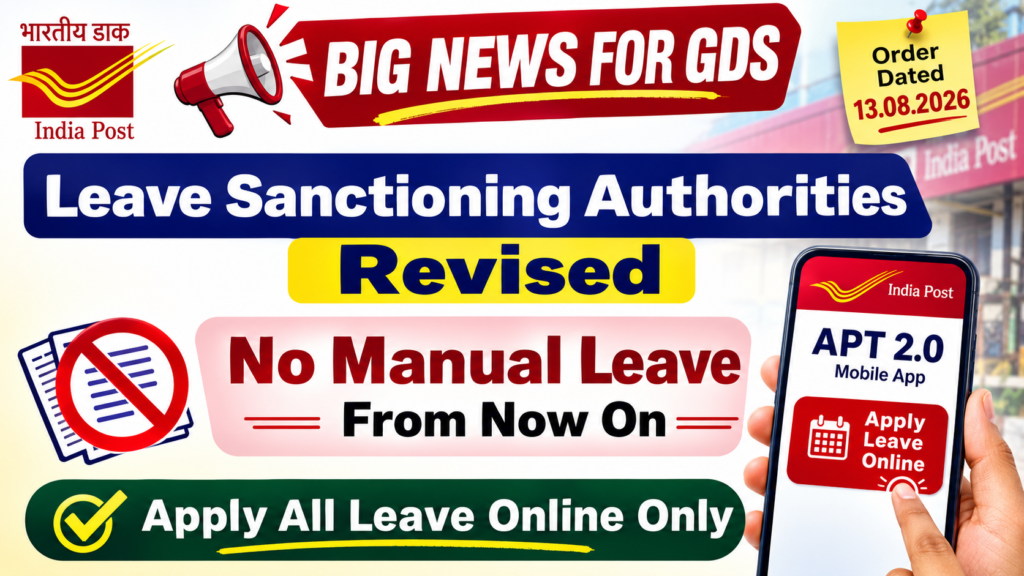
The Department of Posts (GDS Section), Dak Bhawan, New Delhi has issued a letter revising the leave sanctioning authorities for GDS. The order changes who can approve your leave, raises some powers, and makes online leave application compulsory.
If you are a BPM, ABPM or Dak Sevak, please read this carefully. It affects you directly, every single year.
Quick Summary
- Letter Number: 17-31/2016-GDS (Pt-Leave)
- Issued by: Department of Posts, GDS Section, Dak Bhawan, Sansad Marg, New Delhi – 110001
- Date: 13.08.2026
- Issued to: All Chief Postmasters General
- Subject: Revision of leave sanctioning authorities of GDS
- Signed by: Gurvinder Singh, Assistant Director General (GDS/PCC)
- Reason: Following revision of the SEDA (Schedule of Engaging, Disciplinary and Appellate Authorities) for GDS vide order dated 26.11.2025, many Circles asked for clarification on who is competent to sanction leave and approve substitute arrangements.
The Biggest Change – No More Manual Leave
Read this line carefully, because it changes your daily routine.
“No leave will be approved to GDS in manual mode.”
The letter states that a provision already exists in APT 2.0 and the mobile app for applying for all kinds of leave. So GDS must now apply for all admissible leave through online mode only, for:
- Online record
- Speedy approval
- End-to-end tracking
Stop writing paper leave applications. If your leave is not in the system, it does not exist. Learn the app today, not on the day you need emergency leave.
Types of Leave Available to GDS
The letter also restates your leave entitlement in one place. Save this section.
1. Paid Leave (PL)
- 10 days in each half-year
- Can be accumulated up to a maximum of 45 days
- No leave encashment facility
2. Leave Without Allowance (LWA)
- Up to 180 days in a calendar year under normal circumstances
- Beyond 180 days only in specified cases (explained below)
3. Emergency Leave
- Up to 5 days in a calendar year to meet emergent requirements
4. Maternity Leave
- 180 days of paid leave for female GDS as per prescribed conditions
- In case of miscarriage, including abortion, maternity leave not exceeding 45 days may be granted to a female GDS, irrespective of the number of surviving children, during her entire service, on production of a medical certificate from a Government Medical Practitioner
Ten Key Changes in Simple Words
- Leave sanctioning authorities are now aligned with the revised SEDA, and existing instructions on leave and substitute arrangements are consolidated in one place.
- Powers for LWA, Paid Leave and Emergency Leave are decentralised – delegated to HSG-I Postmasters and Senior Postmasters / Deputy Chief Postmasters / Officers-in-Charge of Independent Units for Dak Sevaks working in their offices. Units headed by PS Group B officers and above may further delegate these powers to officers not below the rank of Inspector (Posts) / HSG-I in that office.
- Big gain for BPMs: the LWA power of Sub-Divisional Heads for BPMs has been increased from 60 days to 90 days, bringing it at par with the existing power for ABPMs and Dak Sevaks.
- Divisional Heads / Unit Heads will now sanction LWA beyond 90 days and up to 180 days uniformly for all categories of GDS.
- The power to sanction LWA beyond 180 days on grounds of genuine illness, earlier with the Head of Circle only, is now extended to the Head of Region as well – so such cases will be decided faster.
- No change in the powers of Divisional / Unit Heads for Paid Leave, Emergency Leave and Maternity Leave. However, in Units or Divisions headed by officers above PS Group B level, these powers may be delegated to an officer not below PS Group B.
- No change in the power of the CPMG to sanction leave beyond 180 days to recognised National-level GDS Union functionaries.
- LWA exceeding 180 days will continue to be allowed only in these three situations:
- Officiating against MTS / Postman posts
- Deputation to IPPB or any other office notified by the Department
- Cases of genuine illness
- Very important: the leave sanctioning authority is now also competent to approve substitute arrangements within its delegated powers. All existing guidelines and instructions on substitute arrangements stand superseded.
- All leave must be applied online through APT 2.0 or the mobile app. Manual mode is not allowed.
Annexure – Revised Leave Sanctioning Powers
1. LWA (Leave Without Allowances)
| S.No | Authority to Grant Leave | For BPM | For ABPM / DS |
|---|---|---|---|
| (i) | HSG-I Postmaster | N.A. | Up to 90 days # |
| (ii) | Senior Postmaster / Deputy Chief Postmaster / Officer in charge of the Independent Unit not below the rank of Inspector Posts / HSG-I | N.A. | Up to 90 days #$ |
| (iii) | Sub Divisional Head | Up to 90 days | Up to 90 days @ |
| (iv) | Divisional Head / Unit Head (PS Group B and above) | >90 to 180 days % (i) Up to 180 days for Union Functionaries % (ii) >180 days for officiating as MTS/Postman % | >90 to 180 days % (i) Up to 180 days for Union Functionaries % (ii) >180 days for officiating as MTS/Postman % |
| (v) | Head of Circle (HOC) / Head of Region (HOR) | May grant leave >180 days on the ground of genuine illness | May grant leave >180 days on the ground of genuine illness |
| (vi) | CPMG | Beyond 180 days – for Recognized GDS Union Functionaries at National Level | Beyond 180 days – for Recognized GDS Union Functionaries at National Level |
2. Paid Leave (Maximum Limit up to 45 days)
| S.No | Competent Authority | For BPM | For ABPM / DS |
|---|---|---|---|
| (i) | HSG-I Postmasters | N.A. | Full Power # |
| (ii) | Senior Postmaster / Deputy Chief Postmaster / Officer In charge of the Independent Unit not below the rank of Inspector Posts / HSG-I | N.A. | Full Power #$ |
| (iii) | Sub Divisional Head | Full Power | Full Power @ |
| (iv) | Divisional Head / Unit headed by PS Group B and above | Full Power % | Full Power % |
3. Emergency Leave (up to 5 days)
| S.No | Competent Authority | For BPM | For ABPM / DS |
|---|---|---|---|
| (i) | HSG-I Postmasters | N.A. | Full Power # |
| (ii) | Senior Postmaster / Deputy Chief Postmaster / Officer in charge of the Independent Unit not below the rank of Inspector Posts / HSG-I | N.A. | Full Power #$ |
| (iii) | Sub Divisional Head | Full Power | Full Power @ |
| (iv) | Divisional Head / Unit headed by PS Group B and above | Full Power % | Full Power % |
4. Maternity Leave (180 days / 45 days in case of miscarriage, including abortion)
| S.No | Competent Authority | For BPM | For ABPM / DS |
|---|---|---|---|
| (i) | Divisional Head / Unit headed by PS Group B and above | Full Power % | Full Power % |
What Do the Symbols Mean?
These footnotes decide whether an authority actually applies to you, so read them once properly:
- # – Only for Dak Sevaks working in the same Post Office
- $ – The Officer In-charge may delegate the power to an officer not below the rank of Inspector Posts / HSG-I in the same office
- @ – Except for the Dak Sevaks in the offices covered at (i) and (ii) above
- % – Power may be delegated by the Divisional Head / Unit Head to an officer not below PS Group B Level
- * – No LWA exceeding 180 days is admissible to a GDS, except when granted for officiating against MTS/Postman posts, on deputation to IPPB or any other notified office, or on grounds of genuine illness
Who Should You Approach for Which Leave?
Simple practical guide:
If you are an ABPM or Dak Sevak in a Post Office headed by an HSG-I Postmaster:
- Paid Leave and Emergency Leave → your own HSG-I Postmaster has full power
- LWA up to 90 days → same officer
If you are a BPM:
- Paid Leave and Emergency Leave → Sub Divisional Head has full power
- LWA up to 90 days → Sub Divisional Head (this is the new enhanced limit)
- LWA above 90 up to 180 days → Divisional Head / Unit Head
For everyone:
- LWA above 180 days for genuine illness → Head of Region or Head of Circle
- Maternity Leave → Divisional Head / Unit Head
Note the pattern – the routine leave you actually use most has moved closer to your own office. That was the whole point of this order.
Why This Order Matters
Three real benefits for GDS:
- Faster approval. Your Paid Leave and Emergency Leave no longer need to travel up to the Divisional Office in many cases.
- BPMs get equal treatment. The 60-day LWA limit was always lower than what ABPMs enjoyed. That gap is now closed at 90 days.
- Substitute arrangement confusion ends. Earlier, one officer sanctioned leave and the substitute approval sat somewhere else. Now the same authority does both.
And one responsibility for you – learn the online leave process in APT 2.0 or the mobile app. No manual leave will be approved.
For GDS Who Want to Move Up
Notice something in this very order. LWA beyond 180 days is allowed for GDS officiating against MTS / Postman posts. The department clearly expects GDS to move into those roles.
That movement happens through departmental exams:
- GDS ➜ MTS – through the GDS to MTS Departmental Exam
- GDS ➜ Postman / Mail Guard
- GDS ➜ PA/SA – as Category C candidates in LDCE/CE
- MTS ➜ Postal Assistant / Sorting Assistant
- Postman ➜ Postal Assistant / Sorting Assistant
- PA/SA ➜ LSG ➜ HSG-II ➜ HSG-I
Interesting point – the HSG-I Postmaster who now sanctions your leave sits at step 6 of this same ladder. Everyone on it started somewhere.
Start Your GDS to MTS Preparation Today
If you are serious about promotion, this is what actually works:
- Correct GDS to MTS Syllabus and GDS to MTS Exam Pattern
- GDS to MTS Previous Year Question Papers PDF and GDS to MTS Question Bank
- GDS to MTS Mock Test and daily practice sets
- GDS to MTS Study Material written for departmental candidates, not general competitive exams
- GDS to Postman Coaching and GDS to Mail Guard preparation
- DEST typing practice, if you are aiming directly at PA/SA
- Daily India Post GK, Current Affairs and Circulars – orders like this one are exactly what gets asked
Our Complete India Post Departmental Exam Coaching
We help postal staff in every circle – Punjab, Haryana, Himachal Pradesh, Delhi, Uttar Pradesh, Rajasthan, Bihar, Madhya Pradesh, Maharashtra, Gujarat, Tamil Nadu, Karnataka, Kerala, Odisha, Assam, West Bengal, Andhra Pradesh and Telangana.
- GDS to MTS Online Classes and GDS to MTS Complete Course
- MTS to PA Online Classes and Postman to PA Course
- PA SA Online Classes with DEST typing modules
- GDS to MTS Live Classes and recorded classes for after-duty study
- India Post Mock Tests, question banks and practice sets
- Daily India Post GK, Current Affairs and Quiz
- Doubt support in Hindi and English
Frequently Asked Questions
Q1. Can GDS still apply for leave on paper? No. The order clearly states that no leave will be approved to GDS in manual mode. All leave must be applied through APT 2.0 or the mobile app.
Q2. How much Paid Leave does a GDS get? 10 days in each half-year, accumulable up to a maximum of 45 days. There is no leave encashment facility.
Q3. What is the new LWA power of the Sub Divisional Head for BPMs? It has been increased from 60 days to 90 days, bringing BPMs at par with ABPMs and Dak Sevaks.
Q4. Who sanctions LWA beyond 180 days for genuine illness? The Head of Region or the Head of Circle. Earlier this power rested only with the Head of Circle.
Q5. When is LWA beyond 180 days allowed at all? Only in three situations – officiating against MTS/Postman posts, deputation to IPPB or another notified office, and genuine illness.
Q6. How much maternity leave can a female GDS get? 180 days of paid leave as per prescribed conditions. In case of miscarriage including abortion, up to 45 days may be granted irrespective of the number of surviving children, on a medical certificate from a Government Medical Practitioner.
Q7. Who approves substitute arrangements now? The same authority that sanctions the leave, within its delegated powers. Earlier separate instructions on substitute arrangements now stand superseded.
Q8. How much Emergency Leave is available? Up to 5 days in a calendar year.
Stay Updated
Always read the original letter before applying, and confirm the competent authority for your own office with your Divisional Office.
For daily India Post Departmental Exam updates, India Post Circulars, previous year question papers and free mock tests, keep visiting our website.