
SEO setup (for your CMS, not for the page body)
| Field | What to use |
|---|---|
| SEO title (under 60 characters) | India Post Cyber Awareness Session on Phishing & AI Attacks |
| (under 160 characters) | India Post and NIC hold a Cyber Awareness Session on phishing and AI-based attacks on 14.10.2026 at Dak Bhawan. Details and safety tips inside. |
| URL slug | /india-post-cyber-awareness-session-phishing-ai-attacks-2026 |
| Focus keyword | India Post Cyber Awareness Session |
| Secondary keywords | India Post Latest News, India Post Circulars, India Post Current Affairs, India Post GK, Cyber Awareness Month 2026 |
| Category | India Post Circulars |
| Tags | India Post, Cyber Security, Phishing, AI Scams, NIC, Dak Bhawan, Cyber Awareness Month, CEPT |
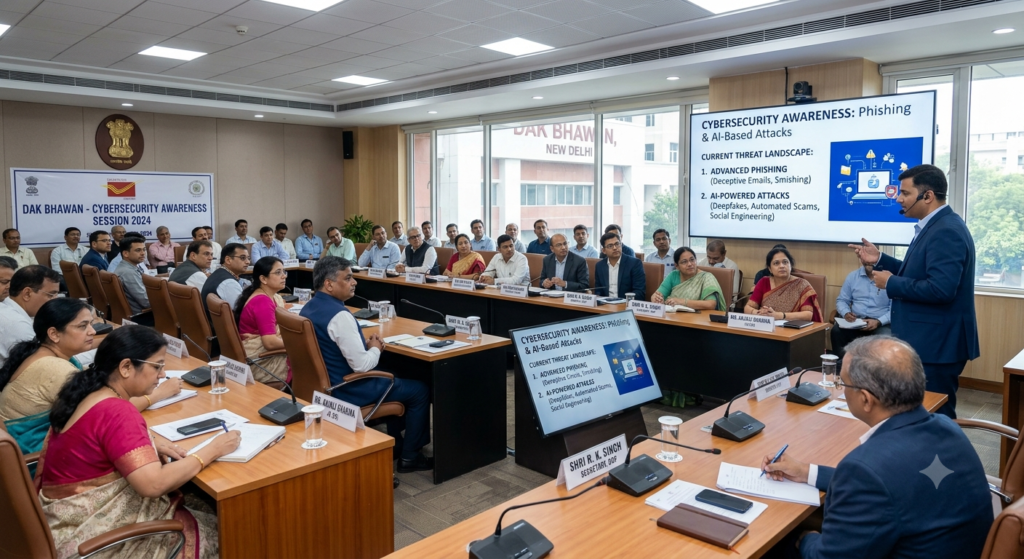
| Featured image alt text | India Post cyber awareness session on phishing and AI-based attacks at Dak Bhawan |
India Post holds a cyber safety session for its officials
The Department of Posts has organised a Cyber Awareness Session on “Phishing and AI-Based Attacks” for its officials. It is part of Cyber Awareness Month and is being held with the National Informatics Centre (NIC).
The session is on 14 October 2026 at 11:00 AM in Dak Bhawan, New Delhi. The aim is simple: help postal staff spot fake emails, fake calls and new AI-based tricks used by cyber criminals.
Let us look at the details in easy words.
Quick facts at a glance
| Point | Details |
|---|---|
| Memo number | Tgy-50/20/2025-Technology-DOP |
| Memo date | 13.10.2026 |
| Issued by | Project Management Unit, Department of Posts, Dak Bhawan, New Delhi |
| Signed by | Muhammad Sahid, ADG (PMU-II) |
| Topic | Phishing and AI-Based Attacks |
| Occasion | Cyber Awareness Month |
| In partnership with | National Informatics Centre (NIC) |
| Speaker | Shri Ajay Sharma, Joint Director, NIC and Deputy Chief Information Security Officer (Dy. CISO) |
| Date | 14.10.2026 (Wednesday) |
| Time | 11:00 AM onwards |
| Venue | G.P. Roy Room, 2nd Floor, Dak Bhawan, New Delhi |
Who should attend?
The memo asks these officials to join the session:
- All officials posted in the Postal Directorate
- Officials of the PLI Directorate
- Officials of the Parcel & CCS Directorate
- Officials of CEPT
- AD (Technology) of all Circles, as directed by their Chief Postmasters General
The memo was also sent to the CGM (PLI), CGM (Parcel & CCS), GM CEPT Bengaluru and all DDsG at Dak Bhawan.
What will the session cover?
- How phishing works and how to spot it
- New cyber threats that use Artificial Intelligence (AI)
- How AI-based attacks are carried out and how to stay safe from them
Simple cyber safety tips for every postal employee
You may not be in Dak Bhawan, but these threats reach every post office. Here are some easy habits to follow.
What is phishing? Phishing is when a criminal sends a fake email, SMS or link that looks real. The goal is to steal your password, OTP or money.
What are AI-based attacks? Criminals now use AI to write perfect fake emails, copy a senior officer’s voice on a call, or make fake videos. These look and sound very real.
Stay safe with these habits:
- Never share your OTP, password or login ID with anyone, even if the caller says they are from the office.
- Check the sender’s email address carefully before clicking any link.
- Do not open attachments from unknown senders.
- If a “senior officer” calls or messages asking for urgent money or data, confirm on their official number first.
- Be careful of fake India Post SMS about parcels on hold or address updates.
- Use strong passwords and do not reuse them.
- Log out of office systems when you leave your seat.
- Report anything suspicious to your IT or System Administrator at once.
Why this matters for you
India Post handles savings, insurance and payments for crores of people. One wrong click can put public money and data at risk. That is why cyber safety is now part of every postal job.
Useful for exam preparation too
Questions on India Post initiatives, NIC and cyber security often appear in departmental exams as GK and current affairs. Note these points:
- NIC stands for National Informatics Centre.
- CISO stands for Chief Information Security Officer.
- CEPT is the Centre for Excellence in Postal Technology.
- October is observed as Cyber Awareness Month.
Helpful links for your preparation
- India Post GK and Current Affairs
- India Post Quiz and Mock Tests
- GDS to MTS and GDS to Postman Online Classes
- MTS to PA and Postman to PA Online Classes
- India Post Previous Year Question Papers
(Add your internal page links to each line above.)
Frequently asked questions
Q1. What is the topic of the India Post cyber awareness session? “Phishing and AI-Based Attacks”.
Q2. When and where is the session? On 14 October 2026 from 11:00 AM, in the G.P. Roy Room, 2nd Floor, Dak Bhawan, New Delhi.
Q3. Who is the speaker? Shri Ajay Sharma, Joint Director at NIC and Deputy CISO.
Q4. Who has been asked to attend? Officials of the Postal Directorate, PLI Directorate, Parcel & CCS Directorate, CEPT, and AD (Technology) of all Circles.
Q5. Why is this session being held? It is part of Cyber Awareness Month, to make staff aware of phishing and new AI-based cyber threats.
Q6. Which organisation is India Post working with? The National Informatics Centre (NIC).