
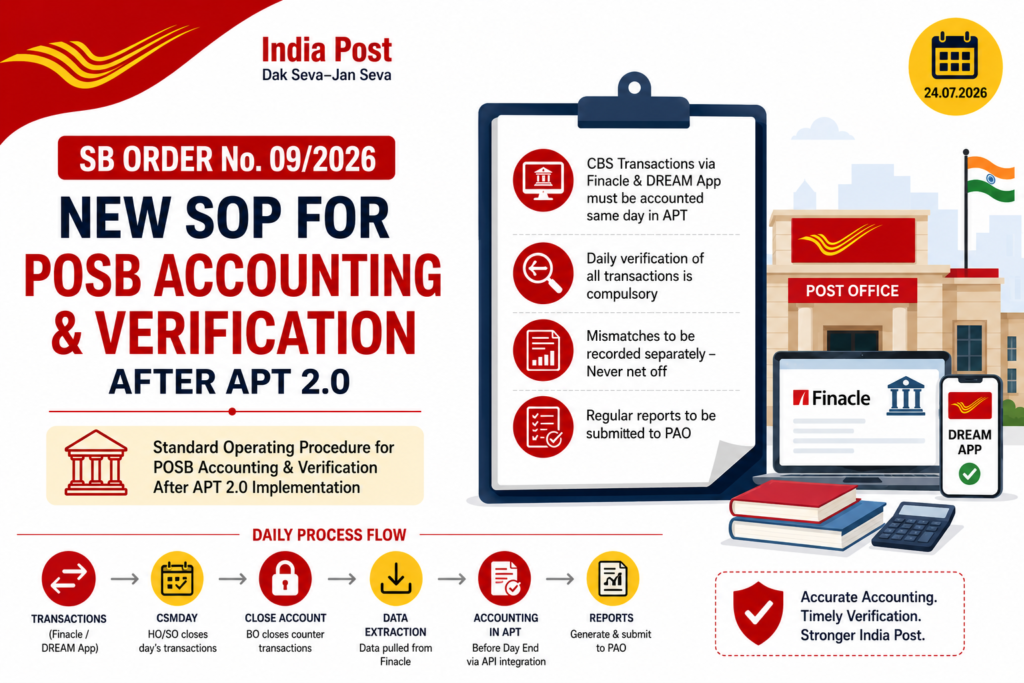
India Post SB Order No. 09/2026 explains new SOP for POSB accounting and verification after APT 2.0. Simple summary plus useful job knowledge for GDS to MTS, MTS to PA, and Postman to PA exam aspirants.
What Is This Order About? (India Post Circulars Update)
Department of Posts, Financial Services Division, has released SB Order No. 09/2026 dated 24.07.2026. This order gives a Standard Operating Procedure (SOP) for accounting and verification of POSB (Post Office Savings Bank) transactions after the implementation of APT 2.0.
Here is the simple summary of this order:
- Order Number: F.No. FS-16/2/2024-FS-DOP
- Issued from Dak Bhawan, New Delhi
- This SOP is based on two earlier orders: SB Order No. 12/2025 and SB Order No. 16/2025.
- CBS (Core Banking Solution) transactions done through Finacle and the DREAM App must be accounted the same day in the APT Application, using API integration before Day End.
- This applies to Branch Offices (BOs), Sub Offices (SOs), Head Offices (HOs), and SBCO.
- Daily verification of transactions is compulsory.
- Past pending POSB transactions must also be verified.
- A regular report has to be submitted to the PAO (Pay and Accounts Office).
How the Daily Process Works (Simple Explanation)
The order explains a simple day-end flow that every post office must follow:
- Transactions: All CBS transactions happen in Finacle or the DREAM App.
- CSMDAY: HO or SO closes the day’s transactions in Finacle.
- Close Account: BOs mark their counter transactions as closed in the DREAM App.
- Data Extraction: CBS data is pulled out from Finacle for accounting in APT.
Important rule: Once CSMDAY is done in HO/SO, or Close Account is done in BO, no more transactions can be added for that day.
Golden Rule: Mismatches Should Never Be Combined
This is one of the most important points in the order:
- If there is a CBS Receipt Mismatch and a CBS Payment Mismatch, both must be recorded separately.
- For example, if Receipt Mismatch is ₹5,000 and Payment Mismatch is ₹2,000, both figures should be shown separately.
- It is wrong to net them off and show only ₹3,000. Doing this hides the real numbers and gives a wrong closing balance.
Responsibility at Different Levels
The SOP divides work into clear levels:
- Level 1 – Branch Post Offices (DREAM App): Start day, do transactions only in DREAM App, check pending items, generate Daily Transaction Report, and report mismatches to the Account Office.
- Level 2 – HO/SO Own Transactions: Use Finacle only, avoid duplicate cheque entries, tally the Daily Transaction Report before Day End.
- Level 3 – HO/SO Subordinate Office Transactions: Generate reports, verify data, reconcile discrepancies, and inform the Account Office through SODA.
- Level 4 – SBCO at Head Post Offices: Generate GL reports, download Cash Book, compare daily figures, trace mismatches, and maintain a Discrepancy Register.
- Level 5 – Postmaster’s Duties: Ensure all transactions are completed properly, mismatches are adjusted, and monthly reports are signed and submitted on time.
- Levels 6 & 7 – Monitoring and Inspection: Sub Divisional Office, Divisional Office, and Inspecting Authorities check that everyone is following this SOP correctly.
Key Numbers to Remember
- 7 levels of responsibility in this SOP.
- Monthly report due by the 4th of every month to PAO.
- 3 prescribed formats under Annexure-IV.
- 3 months of SFTP data retention.
Why This Matters for GDS, MTS, Postman, and PA Aspirants
This SOP is not just for current staff. It is also useful job knowledge for those preparing for internal exams:
- If you are preparing for MTS to PA Departmental Exam, Postman to PA Departmental Exam, or GDS to MTS Departmental Exam, understanding basic POSB accounting concepts like Finacle, DREAM App, CBS transactions, and mismatch handling can help you in the job later.
- Many Postal Assistant Study Material sources include topics related to POSB rules, accounting procedures, and SB Orders. So reading actual circulars like this one gives you real exposure.
- Following India Post Circulars and India Post Latest News daily helps you stay updated with new procedures that may also appear in your GDS to MTS Syllabus or MTS to PA Syllabus as general awareness or departmental knowledge questions.
Quick Recap: What Aspirants Should Do Right Now
If you are targeting:
- GDS to MTS Exam
- MTS to PA Exam (also known as MTS to SA)
- Postman to PA Exam
- GDS to Postman or GDS to Mail Guard Exam
Then follow this simple routine:
- Read India Post Latest News and India Post Circulars daily, including SB Orders like this one.
- Study the GDS to MTS Syllabus and GDS to MTS Exam Pattern properly.
- Practice GDS to MTS Previous Year Question Papers and use a good GDS to MTS Question Bank.
- Take a GDS to MTS Mock Test or Postal Assistant Mock Test daily.
- Join a proper GDS to MTS Online Classes or GDS to MTS Coaching program instead of preparing alone.
- Keep your GDS to MTS Study Material updated with the latest GDS to MTS Notification PDF.
About GDS to MTS, MTS to PA, and Postman to PA Exams (Short Overview)
For new aspirants, here is a simple explanation:
- GDS to MTS: For Gramin Dak Sevaks (GDS) who want to become Multi Tasking Staff (MTS).
- MTS to PA / MTS to SA: For MTS employees who want to become Postal Assistant (PA) or Sorting Assistant (SA).
- Postman to PA / Postman to SA: For Postman staff who want to move up to Postal Assistant or Sorting Assistant.
- GDS to Postman/Mail Guard: For GDS employees who want to become Postman or Mail Guard.
Each exam has its own Eligibility Criteria, Syllabus, Exam Pattern, Selection Process, and Salary structure after promotion.
Circle-Wise Preparation Tip
Whether you are from GDS to MTS Delhi Circle, Punjab Circle, Haryana Circle, Rajasthan Circle, Uttar Pradesh Circle, Bihar Circle, Odisha Circle, Madhya Pradesh Circle, Maharashtra Circle, Gujarat Circle, Tamil Nadu Circle, Karnataka Circle, Kerala Circle, Assam Circle, or West Bengal Circle, always combine your circle-specific notification with general India Post Departmental Exam preparation.
Final Words
SB Order No. 09/2026 is a detailed and technical circular, but it shows how India Post is strengthening its accounting systems through APT 2.0, Finacle, and the DREAM App. As a GDS to MTS, MTS to PA, or Postman to PA aspirant, understanding such procedures early gives you an advantage, both for your exam preparation and your future job role.
Keep your GDS to MTS Admit Card, GDS to MTS Result, and GDS to MTS Exam Date pages bookmarked so you never miss an important update.