
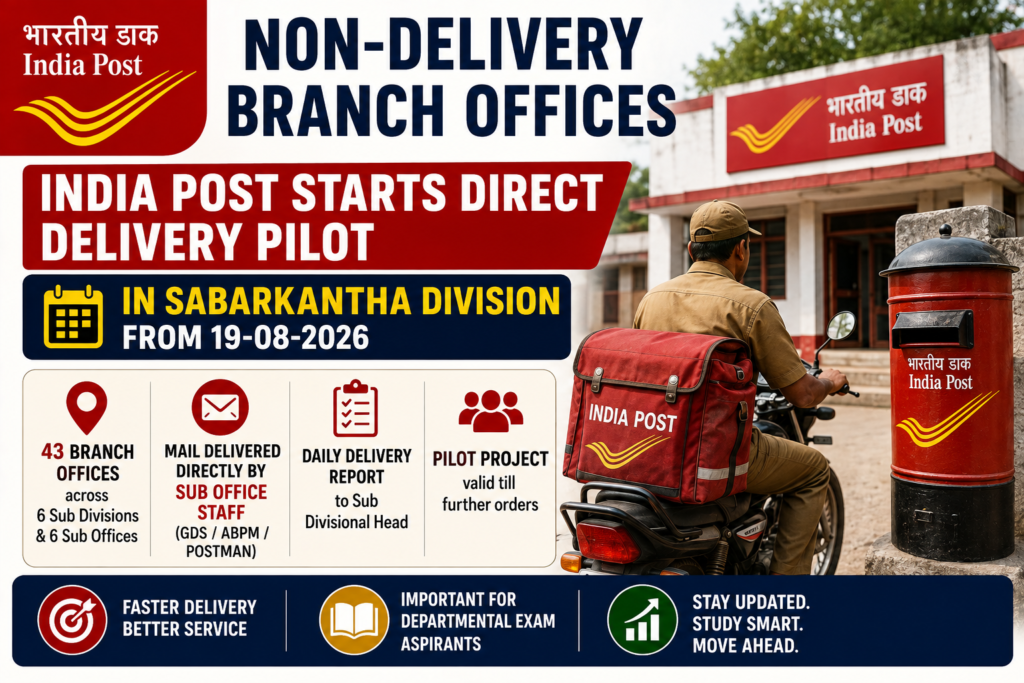
India Post has started a new pilot project in the Sabarkantha Division of Gujarat Circle. From 19 August 2026, mail meant for 43 selected Branch Offices will no longer be routed through those BOs. Instead, the concerned Sub Office will deliver it directly.
If you are a GDS, ABPM, Postman or MTS employee, this is worth reading carefully. Circulars like this one decide your daily work, and they also show up in the general awareness and departmental knowledge portions of India Post departmental exam papers.
Quick Summary of the Circular
| Detail | Information |
|---|---|
| Issued by | Supdt. of Post Offices, Sabarkantha Division, Himatnagar – 383001 |
| Letter No. | G2/Mails/Mail Arrangement 2026-27 |
| Dated | 18-08-2026 |
| Subject | Direct delivery of mail by Sub Offices to identified Non-Delivery Branch Offices |
| Effective from | 19-08-2026, until further orders |
| Type | Pilot project |
| Based on | Circle Office Ahmedabad letter No. ESTA/1-63/7206/2026-CO dated 30-06-2026 and PMG, HQ Region Ahmedabad letter dated 03-07-2026 |
What Is a “Non-Delivery Branch Office”?
In simple words:
- A normal Branch Office receives mail and delivers it in its own area.
- A Non-Delivery BO still does its other counter work, but delivery work is taken away from it.
- The mail for that area is now delivered by staff attached to the Sub Office — that is, the GDS / ABPM / Postman working under the concerned SO.
The idea behind it is faster and more reliable delivery, especially where a BO has very little delivery load or where routing the article through the BO only adds one extra day.
List of Non-Delivery BOs Under Sabarkantha Division
1. South Sub Division — Prantij SO Balisna BO, Dalani Muvadi BO, Kamlpur BO, Karol BO, Majra BO, Oran BO, Pallachar BO, Poglu BO, Sitwada BO, Tajpur BO, Unchha BO, Vadrad BO, Vaghpur BO
2. North Sub Division — Sardoi SO Davli BO, Gadhda BO, Shampur BO
3. Idar Sub Division — Idar MDG SO Barvav BO, Bhavangadh BO, Gambhirpura BO, Laloda BO, Limbhoi BO, Mathasur BO, Netramli BO, Panol BO, Sabalvad BO, Sapawada BO, Surpur BO, Umedpur BO, Ratanpur BO, Lei BO, Pratappura BO
4. Bhiloda Sub Division — Chitroda SO Bolundra BO, Dharapur BO, Mota Kotda BO, Poshina BO, Sabli BO
5. Modasa Sub Division — Dadhalia SO Mahadevgram BO, Moti Isrol BO, Varthu BO
6. Bayad Sub Division — Akrund SO Bordi Timba BO, Chandrej BO, Rampura Kampa BO, Vartakgadh BO
That makes 43 Branch Offices across 6 Sub Divisions and 6 Sub Offices.
Who Has to Do What
Sub Postmasters
- Ensure that all mail and articles received for the listed Non-Delivery BOs are delivered directly to the addressee.
- Delivery must be done through the GDS / ABPM / Postman attached to the Sub Office.
- Make proper arrangements so that delivery happens strictly as per prescribed norms.
- Submit a daily delivery report to the Sub Divisional Head.
Sub Divisional Heads
- Issue instructions to all concerned ABPMs, GDS and Postmen.
- Make temporary arrangements for deployment, delivery and monitoring.
- Monitor the pilot project closely and submit the final conclusion report.
- Report any difficulty to the Divisional Office immediately.
System Administrator
- Make the required changes and updation in the system so that direct delivery through the concerned Sub Offices is possible for the listed BOs.
Branch Postmasters
- Have been marked a copy of the order for information and compliance.
Why This Matters for Departmental Exam Aspirants
Many candidates preparing for GDS to MTS, GDS to Postman / Mail Guard, MTS to PA/SA and Postman to PA promotion exams ignore circulars. That is a mistake.
Here is why:
- Departmental knowledge questions are often framed from mail arrangement, delivery norms and office procedure topics.
- Terms like Non-Delivery BO, MDG, Sub Office, Sub Division and daily report appear directly in question papers.
- Interview and document verification stages sometimes touch on current working arrangements in your own division.
- Understanding real orders makes the GDS to MTS syllabus feel practical instead of theoretical.
So keep a small notebook. Whenever a circular like this comes, write down three things: what changed, from which date, and who is responsible.
Key Points to Remember
- Effective date: 19-08-2026
- Nature: Pilot project, valid till further orders
- Division: Sabarkantha, Gujarat Circle
- Total Non-Delivery BOs: 43
- Delivery staff: GDS / ABPM / Postman of the Sub Office
- Reporting: Daily report to Sub Divisional Head
- Monitoring: Sub Divisional Heads
Preparing for Your Next Promotion Exam
If you are planning to move up from GDS to MTS, or from MTS to Postal Assistant, the working knowledge you gain from such circulars becomes a real advantage. But knowledge alone is not enough — you need structured practice.
A good preparation plan usually includes:
- A clear reading of the GDS to MTS syllabus and exam pattern
- Daily practice from GDS to MTS previous year question papers
- Regular GDS to MTS mock test attempts with timing
- Revision notes on Post Office Guide, mail arrangement and delivery rules
- Doubt clearing with someone who has already cleared the exam
At Postoffice Coaching, we run GDS to MTS online classes, GDS to Postman coaching, MTS to PA online classes and Postman to PA online classes with live sessions, recorded backup, study material, question banks and full-length mock tests. Circle-wise doubts — Gujarat, Punjab, Karnataka, UP, Bihar, Maharashtra and others — are handled in the same batch.
Frequently Asked Questions
Q. Will the Branch Office close down? No. Only the delivery work of the listed BOs has been shifted to the concerned Sub Office. It is a pilot arrangement.
Q. Who will deliver the mail now? The GDS, ABPM or Postman attached to the concerned Sub Office.
Q. Till when is this order valid? From 19-08-2026 until further orders. Since it is a pilot project, a conclusion report will be submitted later.
Q. Does this apply to all divisions? No. This particular order applies only to the Sabarkantha Division. Other divisions may issue their own orders.
Q. Is this useful for the GDS to MTS departmental exam? Yes. Mail arrangement and delivery procedure topics are part of departmental knowledge, and real circulars help you understand them better.
Final Word
Small orders like this one quietly change how thousands of articles move every day. Read them, note them, and connect them with your syllabus. That habit is what separates a candidate who clears the departmental exam in the first attempt from one who keeps waiting for the next notification.