
Published on: 15 August 2026 Document Date: 16 May 2024 Category: GDS Welfare · India Post Circulars · India Post Latest News
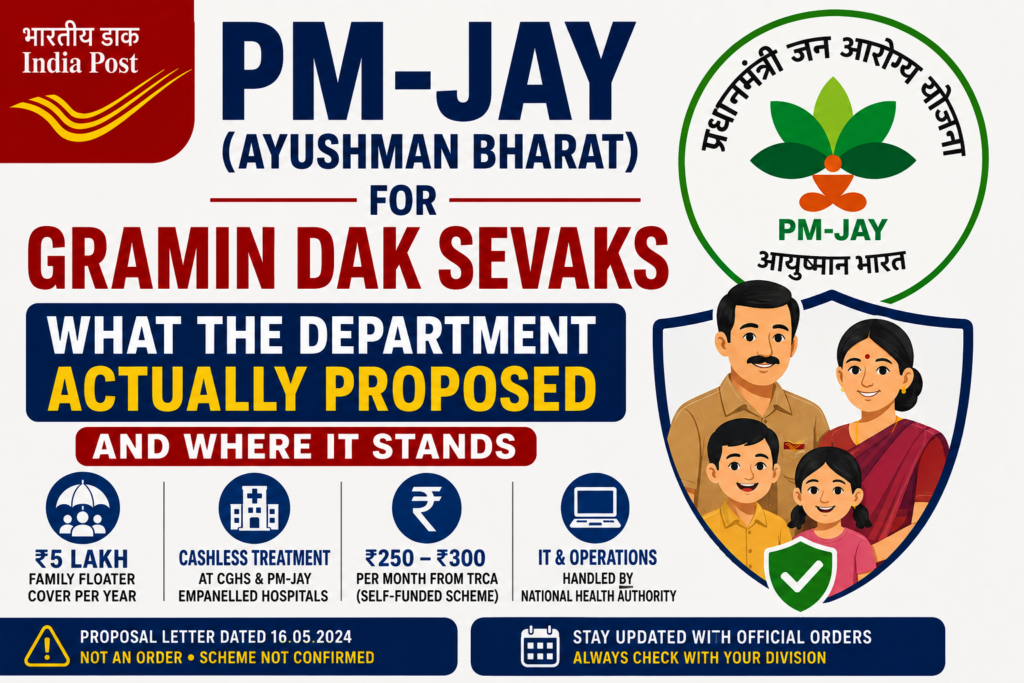
Read this first. The letter discussed below is dated 16.05.2024. It is a proposal letter in which the Department of Posts asked the four recognised GDS unions to give their consent by 22.05.2024. It is not an order launching the scheme.
As of 15 August 2026, we have not seen any Directorate order confirming that the scheme has been launched, that enrolment has opened, or that TRCA deduction has started. If such an order exists, we will update this page immediately. Please do not treat this as an announcement that the scheme is live. Always confirm with your Divisional Office.
What the Letter Says
Letter No. 17-31/2016-GDS-ESIC Issued by: Department of Posts (GDS Section), Dak Bhawan, Sansad Marg, New Delhi – 110001 Signed by: Shri Ravi Pahwa, Assistant Director General (GDS/PCC/PAP) Dated: 16.05.2024
Addressed to the General Secretaries of:
- All India Gramin Dak Sevak Union (AIGDSU)
- All India Postal Employees Union – GDS
- Bhartiya Gramin Dak Sevak Karamchari Sangh (BGDKS)
- National Union of Gramin Dak Sevaks (NUGDS)
Subject: Extension of facilities of Pradhan Mantri Jan Arogya Yojana (PM-JAY) to Gramin Dak Sevaks (GDS) and dependent family members.
The Background — Why PM-JAY At All
This part explains a long-running demand.
- GDS unions had been demanding medical facilities for GDS and their family members for years.
- The Department agreed that GDS need medical cover and explored several options in the past, including the Employees’ State Insurance (ESI) and other insurance service providers.
- None of those options materialised.
- The Department then approached the National Health Authority (NHA) to include GDS and their dependent family members in PM-JAY (Ayushman Bharat).
- The proposal was shared with union representatives during formal and informal meetings.
- After several rounds of discussion, NHA and the Department agreed in principle and an MoU was drafted.
In short: PM-JAY was presented as the only remaining workable route, not as the first choice.
Salient Features of the Proposed Scheme
These are the five points listed in the letter.
1. Coverage Amount
- It is a family floater scheme
- Upper limit of ₹5 lakh per family per year at the time of the letter
- GDS and dependent family members would share that ₹5 lakh limit
- If NHA revises the limit in future, the revised limit would apply to enrolled GDS too
2. Cashless Treatment and What Is Covered
- Cashless healthcare at any public sector hospital and at private network hospitals empanelled under CGHS and PM-JAY
- Wide range of medical and surgical packages — neurosurgery, cardiology and similar
- Oncology with chemotherapy for 50 different types of cancer
- Pre-hospitalisation and post-hospitalisation expenses up to 15 days
- Medicines, medical consumables, diagnostic procedures, medical implantation
- Food services during hospitalisation
3. Contribution — This Is the Part to Read Carefully
- The scheme was proposed to run on a “self-support and self-sustaining basis”
- It would be mandatory for all GDS — not optional
- Contribution of ₹250 to ₹300 per month, to be deducted from the TRCA of the GDS
- The scheme would be reviewed periodically for self-sustainability, and the contribution may be revised in future if considered necessary
So the cover is not free. It is funded by the GDS themselves through a monthly deduction, and the letter explicitly leaves the door open to future increases.
4. States Where PM-JAY Was Not Operational
The letter records that at that time PM-JAY was not in operation in three States/UTs — Delhi, Odisha and West Bengal. Subscribers there were proposed to be covered at Central Government hospitals, including CGHS empanelled hospitals.
Update: Odisha signed an MoU with NHA and became the 34th State/UT to implement Ayushman Bharat PM-JAY in January 2025, so this list has changed since the letter was written. Delhi and West Bengal should be verified independently before you rely on this point.
5. IT and Operations
All IT support and operational aspects would be handled by the National Health Authority, not by the Department of Posts.
Aadhaar Requirement
The letter is clear on this:
- To avail benefits, subscribers and their family members must have Aadhaar updated in the portal
- The Department had already started compiling data of GDS and their dependent family members
- Work on finalising the Standard Operating Procedure (SoP) was underway, as intimated vide letter dated 16 February 2024 to all Heads of Circles
If you are a GDS, keeping your own and your family’s Aadhaar and family details updated in the Department’s records is sensible regardless of when the scheme starts.
The Consent Clause — Why Unions Reacted
This is the paragraph that generated most of the discussion in 2024:
- Unions were asked to furnish their consent by 22.05.2024
- The letter stated that if no comments were received by that date, it would be presumed that the union had no objection, and the Department would proceed to finalise formalities so the scheme could be launched at the earliest
- Unions were also asked to give wide publicity to the scheme’s features among their members, and to advise members to read the detailed features on the National Health Authority website
A deemed-consent clause with a six-day window on a mandatory salary deduction is unusual, and it is the main reason this letter was widely circulated and debated among GDS.
Where Things Stand Today (15 August 2026)
Honest position, stated plainly:
- The letter is a proposal, not a sanction order
- We have found no public Directorate order confirming launch, enrolment, or the start of TRCA deduction
- The Odisha position has changed since the letter was written
- Any figures in the letter — the ₹5 lakh limit, the ₹250–₹300 contribution — were as proposed in May 2024 and may be different whenever the scheme is finally notified
What you should do:
- Do not assume you are covered. Until an order and an enrolment process exist, there is no card and no cashless treatment.
- Check your TRCA statement for any new deduction head. If a deduction appears, ask your Divisional Office for the authority under which it is being made.
- Keep Aadhaar and family member details updated in the Department’s records.
- Follow your union circulars and the Department’s GDS Section orders. Unions were the first to receive this proposal and will be the first to receive the final one.
- If your family currently has no health cover at all, do not wait for this scheme. Check whether your household is separately eligible for PM-JAY on its own criteria, or consider other cover in the meantime.
Frequently Asked Questions
Q. Is PM-JAY already available to all GDS? Not on the basis of this letter. This letter proposed the scheme and sought union consent. No launch order has surfaced publicly as of August 2026.
Q. Will the ₹5 lakh cover be free for GDS? No. As proposed, it is self-funded — ₹250 to ₹300 per month deducted from TRCA, and the scheme was to be mandatory for all GDS.
Q. Is the ₹5 lakh limit per person or per family? Per family. It is a family floater, shared between the GDS and dependent family members.
Q. What if I already have an Ayushman card through my household? That is a separate eligibility route under PM-JAY’s own criteria. The proposal here is a departmental arrangement through an MoU with NHA. Check with your Divisional Office before assuming the two are the same.
Q. Why not ESI for GDS? The letter says ESI and other insurance providers were explored earlier but none of those options finally materialised.
Q. Where can I read the scheme’s own features? The letter itself advises members to go through the detailed features on the National Health Authority website.
Related Guides on Our Website
- GDS to MTS Departmental Exam — Syllabus, Notification and Online Classes
- GDS to MTS Previous Year Question Papers PDF and Mock Test
- GDS to MTS Eligibility Criteria, Selection Process and Salary
- GDS to Postman / Mail Guard Coaching, Syllabus and Study Material
- GDS Salary, TRCA Structure and Allowances Explained
- Service Discharge Benefit Scheme (SDBS) for GDS — How It Works
- India Post Circulars and Latest News
- MTS to PA and Postman to PA Online Classes
- LDCE Inspector Posts 2026 Notification, Syllabus and Apply Online Guide
Final Word
Medical cover for GDS families is a genuine need, and this proposal was a real step towards it. But a proposal from May 2024 is not a benefit in your hand in August 2026.
Treat this page as background on what was proposed and what it would cost you. Watch your union circulars and your TRCA statement for the actual order. We will update this page the moment a launch order is issued.
Sources: Department of Posts letter No. 17-31/2016-GDS-ESIC dated 16.05.2024; public reporting on Odisha’s implementation of Ayushman Bharat PM-JAY in January 2025. For any service or medical benefit matter, rely only on the order issued by your Divisional or Circle office.