
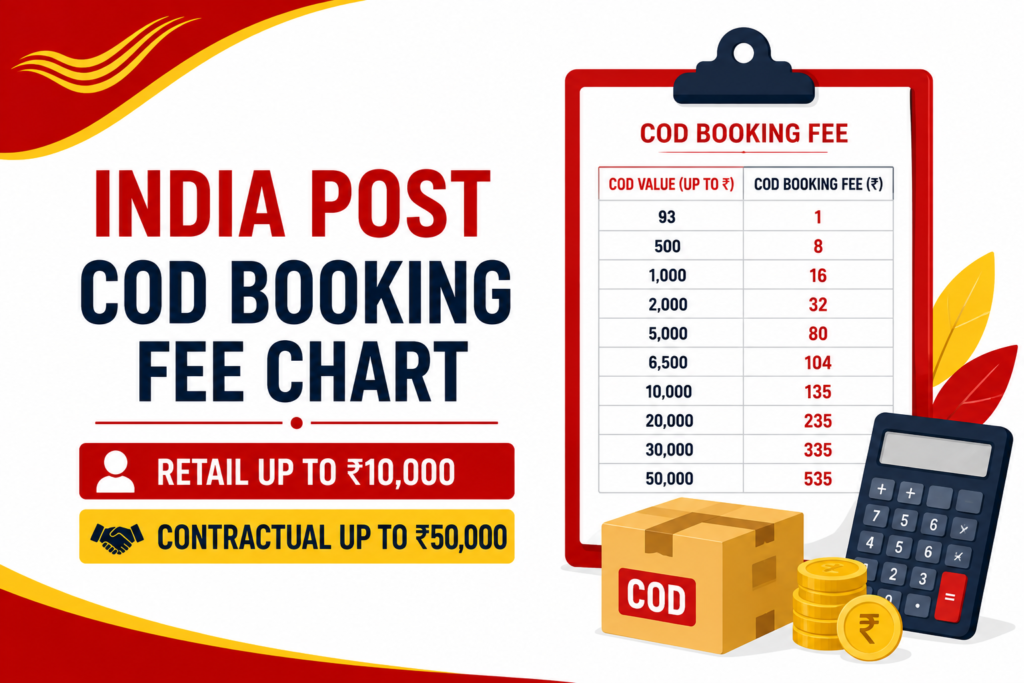
If you work at a post office counter, you deal with COD parcels almost every day. And the one question that slows everyone down is the same — “Is sir, iska COD fee kitna banega?”
This post gives you the complete India Post COD Booking Fee chart in a simple way. No confusion, no long theory. Just the rule, the table, and a few examples you can use at the counter today.
This is also very useful for candidates preparing for the India Post Departmental Exam — because COD, VP, and Speed Post charges are regularly asked in GDS to MTS, GDS to Postman, MTS to PA, and Postman to PA papers.
What is COD in India Post?
COD means Cash on Delivery.
- The sender books a parcel without taking money in advance.
- The postman collects the amount from the receiver at the time of delivery.
- India Post sends that collected amount back to the sender’s account.
- For this service, India Post charges a COD Booking Fee at the time of booking.
Simple words: the fee is the service charge for collecting money on the sender’s behalf.
COD Booking Limits – Retail vs Contractual
This is the first thing to remember, because most counter mistakes happen here.
| Type of Customer | Maximum COD Value Allowed |
|---|---|
| Retail customer (walk-in) | Up to ₹10,000 |
| Contractual customer (agreement/bulk) | Up to ₹50,000 |
- A retail customer cannot book a COD article above ₹10,000.
- Only a contractual customer with an agreement can go up to ₹50,000.
- If someone asks for more than the limit, the booking has to be refused politely.
COD Booking Fee Rule (Only 2 Lines to Remember)
This is the full rule. Learn these two lines and you never need the chart again.
- COD value up to ₹6,500 → 1.6% of the COD value
- COD value above ₹6,500 → ₹100 + 1% of the amount exceeding ₹6,500
That’s it. GST is applicable extra as per rules in force.
How to Calculate – Simple Examples
Example 1: COD value ₹2,000
- Value is below ₹6,500
- 1.6% of 2,000 = ₹32
Example 2: COD value ₹6,500
- 1.6% of 6,500 = ₹104
Example 3: COD value ₹10,000
- Amount above 6,500 = 10,000 − 6,500 = 3,500
- 1% of 3,500 = 35
- 100 + 35 = ₹135
Example 4: COD value ₹50,000 (contractual)
- Amount above 6,500 = 43,500
- 1% of 43,500 = 435
- 100 + 435 = ₹535
Once you do three or four of these by hand, it becomes automatic.
India Post COD Booking Fee – Quick Ready Reckoner
Here are the most commonly booked values. Fee is shown in rupees (excluding GST).
| COD Value (up to ₹) | COD Booking Fee (₹) |
|---|---|
| 93 | 1 |
| 500 | 8 |
| 1,000 | 16 |
| 1,500 | 24 |
| 2,000 | 32 |
| 2,500 | 40 |
| 3,000 | 48 |
| 4,000 | 64 |
| 5,000 | 80 |
| 6,000 | 96 |
| 6,500 | 104 |
| 7,000 | 105 |
| 8,000 | 115 |
| 9,000 | 125 |
| 10,000 (retail limit) | 135 |
| 12,000 | 155 |
| 15,000 | 185 |
| 18,000 | 215 |
| 20,000 | 235 |
| 25,000 | 285 |
| 30,000 | 335 |
| 35,000 | 385 |
| 40,000 | 435 |
| 45,000 | 485 |
| 50,000 (contractual limit) | 535 |
How to read the chart: the value column means “up to”. So if the COD amount is ₹9,600, you look at the next slab (9,649) and charge ₹126. The fee is always rounded up to the next rupee.
Small Trick to Remember the Slabs
- Below ₹6,500, the fee moves up by ₹1 for roughly every ₹62.50 of value.
- Above ₹6,500, the fee moves up by ₹1 for every ₹100 of value.
So above ₹6,500, this shortcut works beautifully:
Fee = 100 + (Amount above 6,500 ÷ 100)
Try it with ₹23,000 → 16,500 ÷ 100 = 165 → 100 + 165 = ₹265. Matches the chart.
Common Mistakes at the Counter
- Booking a COD above ₹10,000 for a retail customer. Not allowed.
- Applying 1.6% on the whole amount even when value is above ₹6,500. Wrong. Above 6,500, it’s flat ₹100 + 1% on the excess only.
- Forgetting that the chart values are “up to” values, not exact values.
- Not adding GST on the service charge.
- Mixing up COD fee with postage. They are separate. Postage is charged as per Speed Post / Parcel rates and COD fee is added on top.
Why This Topic Matters for the Departmental Exam
If you are preparing for a promotion exam, charges and limits are scoring topics. They are short, factual, and repeated year after year.
This topic is directly useful for:
- GDS to MTS Departmental Exam
- GDS to Postman / Mail Guard Exam
- MTS to PA / SA Departmental Exam
- Postman to PA / SA Departmental Exam
- Postal Assistant and Sorting Assistant Exam
Typical questions asked from this area:
- What is the maximum COD amount for a retail customer?
- What is the COD booking fee for a value of ₹10,000?
- Above which value does the flat ₹100 + 1% rule apply?
- What is the maximum COD limit for a contractual customer?
If you are searching for GDS to MTS Study Material, GDS to MTS Previous Year Question Papers, India Post Mock Tests, or MTS to PA Question Paper sets, keep a separate notebook only for charges, limits, and time-lines. That one notebook wins you 8–10 marks.
What Serious Aspirants Should Do Next
The India Post departmental exam is not a difficult exam. It is a details exam. The people who clear it are the ones who revise rules like this again and again.
A good preparation plan should include:
- GDS to MTS Online Classes with live and recorded lectures
- A complete GDS to MTS Course covering the full GDS to MTS Syllabus
- GDS to MTS Previous Year Question Papers PDF and GDS to MTS Practice Set papers
- Regular GDS to MTS Mock Test series with proper analysis
- Updates on GDS to MTS Notification, Admit Card, Exam Date, and Result
- Clarity on GDS to MTS Eligibility Criteria, Selection Process, Exam Pattern, and Salary
The same applies for MTS to PA Online Classes, Postman to PA Coaching, and GDS to Postman Coaching.
Candidates from every circle — Rajasthan, Uttar Pradesh, Bihar, Madhya Pradesh, Delhi, Punjab, Haryana, Maharashtra, Gujarat, Tamil Nadu, Karnataka, Kerala, Odisha, Assam, and West Bengal Circle — appear for the same syllabus, so the preparation strategy stays the same everywhere.
Frequently Asked Questions (FAQ)
Q. What is the maximum COD value for a retail customer in India Post? ₹10,000.
Q. What is the maximum COD value for a contractual customer? ₹50,000.
Q. What is the COD booking fee formula? 1.6% of COD value up to ₹6,500. Above ₹6,500, it is ₹100 + 1% of the amount exceeding ₹6,500.
Q. What is the COD fee for ₹10,000? ₹135, plus GST as applicable.
Q. What is the COD fee for ₹50,000? ₹535, plus GST as applicable.
Q. Is GST included in this chart? No. The chart shows the basic COD booking fee. GST is charged extra as per applicable rules.
Q. Is this chart useful for departmental exams? Yes. Charges and limits are commonly asked in GDS to MTS, GDS to Postman, MTS to PA, and Postman to PA exams.
Final Word
Print this chart, paste it near your counter, and read it once a week. Within a month you will be quoting COD fees without opening any file.
And if you are also preparing for your promotion, treat every rule you use at work as a free exam question. That is the biggest advantage a departmental candidate has over everyone else.
Chart source: India Post COD Booking Fee compilation (Retail up to ₹10,000 / Contractual up to ₹50,000), compiled by Manu VR. Always verify with the latest departmental circular before applying.