
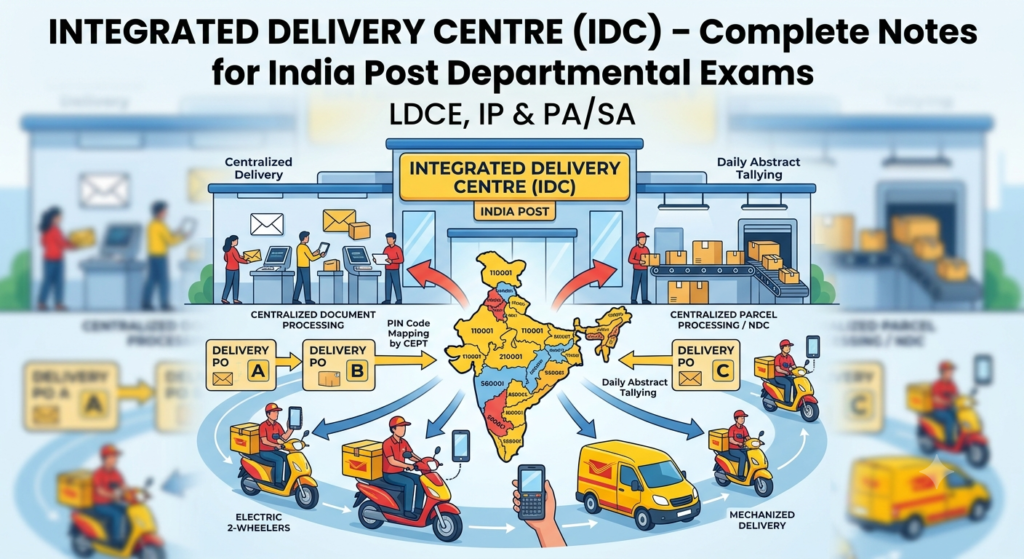
Integrated Delivery Centre IDC Notes for India Post Departmental Exam – Full Guidelines, Norms & MCQs Complete IDC study notes for LDCE, Inspector of Posts and PA/SA departmental exams. Distance limit, staff norms, space, process flow, NDC difference and 10 practice MCQs with answers. URL Slug: /integrated-delivery-centre-idc-notes-india-post-departmental-exam Published: 12 September 2026 | Category: India Post Study Material, India Post Departmental Exam
Why IDC Matters for Your Exam
The Department of Posts issued Policy Guidelines / SOP for centralized delivery of all types of postal articles through Delivery Centres on 17.02.2025, with a clarification on 26.06.2025.
Any topic this new, this operational, and this full of exact numbers is a favourite with paper setters. Expect questions in:
- Inspector of Posts (IP) LDCE
- PA/SA departmental exam (Paper on Postal Manuals & Operations)
- Postman to PA and MTS to PA departmental exams
- Departmental promotion exams and internal quizzes
The good news: IDC is a small chapter with fixed figures. Learn the numbers once and you can score full marks on it.
1. What Is an Integrated Delivery Centre?
In plain words, an IDC is one big delivery hub that replaces the scattered delivery work of several nearby post offices.
- Delivery areas of adjoining delivery Post Offices may be merged under one newly established Delivery Centre.
- Existing delivery beats may be discontinued and delivery areas redesigned or recalibrated for the whole IDC area.
- The purpose is centralized delivery of documents, parcels and other articles with standardized processing and mechanized delivery.
- Document and parcel processing areas should ideally be adjacent, with a common bag receipt/dispatch area.
2. Area / Catchment Rule
- One-way delivery distance: normally not more than 15 km.
- It may exceed 15 km in exceptional circumstances, based on operational requirements.
- Delivery PIN codes/areas of adjoining POs may be consolidated.
- How many IDCs a city gets depends on workload, distance, geographical divide, available space and local circumstances.
Exam tip: the answer is 15 km, but remember the word “normally”. Questions often test whether you know it can be exceeded.
3. IDC Establishment Numbers (Most Asked Table)
| Location / Category | Delivery Staff | Max Accountable Articles/Day* | Approx. Space |
|---|---|---|---|
| Metro / other big cities | 50 – 80 | 8,000 | 2,000 – 3,500 sq ft |
| State capital / other cities | 15 – 60 | 5,000 | 1,000 – 2,500 sq ft |
*Excluding bulk articles.
Two extra points that make good tricky questions:
- “Metro / other big cities” here means cities delivering more than 50,000 accountable articles/parcels per day (excluding bulk).
- If adequate space exists, the 50–80 staff range may be exceeded.
4. Delivery Staff Article Norms
This is the second most likely table to appear in your paper.
| Type of Article | Tentative Articles per Delivery Staff |
|---|---|
| Ordinary articles | 95 |
| Registered articles / Speed Post document | 42 |
| Specific / Parcels – Speed Post (document) | 43 |
| Money Order / eMO | 1 |
| COD | 3 |
| Insured | 1 |
| Exclusive parcel delivery staff (SP / Business / Registered Parcel) | 60 parcels |
Assumptions behind these numbers:
- Travel of 30 km in less-congested areas and 18 km in congested areas
- 90 minutes travel time
- Bulk articles are excluded while calculating staff requirement
- One or two bulk delivery staff, or as required, are identified separately
Easy way to remember: 95 – 42 – 43 – 1 – 3 – 1. Say it out loud a few times. The 42/43 pair and the 1/3/1 group are where most candidates slip.
5. Parcel and NDC Integration
- Parcels should, as far as possible, be delivered through Delivery Centres, with parcel processing areas separately identified.
- Existing NDCs in a city may be merged with Delivery Centres immediately, or gradually if immediate merger is not feasible.
- New NDCs opened due to space constraints may also be merged over time.
- If separate parcel delivery staff is justified, a separate parcel delivery area may be carved out — and it need not be co-terminus with the document delivery area.
- If separate parcel staff is not justified, common staff deliver both documents and parcels.
6. Mechanized Delivery
- All delivery areas should be mechanized.
- 2-wheelers → documents and small parcels
- 4-wheelers → big / heavy parcels
- Fuel reimbursement for own 2-wheeler follows the applicable Postal Directorate policy.
- Electric 2-wheelers may be hired through tender where required; 4-wheelers hired as per existing practice.
7. Space, Facility & Infrastructure
- Adequate parking for 2-wheelers and 4-wheelers.
- A separate Facility ID for each Delivery Centre and Nodal Delivery Centre, for separate CSI identity and BI/MIS monitoring.
- A ramp at the entry for receipt and dispatch of bags through bag trolley.
- Bag receipt, bag opening and processing areas marked as per the defined process flow.
- Operational equipment includes computers and scanners as specified in the annexures/layout guidelines.
8. Staff Deployment & PIN Code
- At the time of selecting departmental or GDS delivery staff, availability of a 2-wheeler and a smart mobile phone must be ensured.
- The IDC may be assigned the PIN code of any merged delivery Post Office — ideally the PIN code of the major delivery PO.
- CEPT maps the delivery PIN codes to the Delivery Centre PIN code and makes the BI/MIS changes.
Exam tip: “Who does the PIN code mapping?” → CEPT. Simple one-mark question.
9. IDC Process Flow (Learn the Sequence)
Bag receipt → Bag receipt scan → Opening → Receipt scan → Segregation / Sorting → Sequencing → Scanning & Delivery Slip → Out for Delivery → Delivery → Staff return → Bag dispatch to Sorting Hub → Tallying of Abstract
Also remember:
- In a mix delivery area, one common delivery slip can contain Speed Post documents, Registered Post and parcels.
- Where there is a separate parcel area, separate delivery slips are generated.
Sequence questions (“which comes immediately after X?”) are very common. Write this flow from memory three times and you will not forget it.
10. Daily Control & Accountability
- Bags must be scanned at the actual receipt from the mail motor and the actual dispatch through the mail motor.
- Bag Abstract and Article Abstract must be tallied daily.
- The Supervisor / In-charge has personal responsibility for the daily tallying.
- A Bulk Delivery Slip is generated for bulk articles.
Exam tip: Responsibility questions almost always point to the Supervisor/In-charge. Do not pick “Sorting Assistant only”.
11. Technology and Customer Interface
The Postman Mobile App / IT 2.0 is intended to support:
- Route optimization
- Paperless delivery
- OTP-based delivery
- Digital collection of payment
- App-based calling
Also:
- Delivery staff may call the addressee before visiting to speed up delivery.
- For eMO / COD / custom-duty articles, cash is collected and settled through the designated official/process at the Delivery Centre; digital COD and custom-duty collections are settled as prescribed.
12. IDC vs NDC – The Distinction Examiners Love
| Model | Document Processing | Parcel Processing | Delivery Staff |
|---|---|---|---|
| Integrated / co-located | Adjacent | Adjacent | Mix staff or separate parcel staff |
| Same compound, separate areas | Separate | Separate | Separate document & parcel staff |
The key sentence to memorise: where document and parcel processing areas are separate but in the same compound, the document centre is called the Delivery Centre and the parcel centre is called the Nodal Delivery Centre (NDC).
13. One-Page Revision Chart
| Item | Remember |
|---|---|
| Catchment | Adjoining delivery POs can be merged |
| One-way distance | Normally ≤ 15 km |
| Metro / big city staff | 50 – 80 |
| Metro / big city max accountable articles | 8,000 / day |
| Metro / big city space | 2,000 – 3,500 sq ft |
| State capital / other city staff | 15 – 60 |
| State capital / other city max accountable articles | 5,000 / day |
| State capital / other city space | 1,000 – 2,500 sq ft |
| Parcel-only staff norm | 60 parcels |
| Ordinary / Regd-SP / Parcel-SP / eMO / COD / Insured | 95 / 42 / 43 / 1 / 3 / 1 |
| Vehicles | 2W = documents & small parcels; 4W = big/heavy parcels |
| PIN code mapping | Done by CEPT |
| Daily tallying responsibility | Supervisor / In-charge |
Screenshot this table. It is enough for a last-minute revision the night before the exam.
14. Practice MCQs with Answers
1. The normal maximum one-way distance for delivery staff in an IDC is: A) 5 km B) 10 km C) 15 km D) 20 km → Answer: C
2. An IDC in a State Capital / other city may normally cater to: A) 5–15 staff B) 15–60 staff C) 50–80 staff D) 80–100 staff → Answer: B
3. Maximum accountable articles/day for a State Capital / other city IDC is: A) 3,000 B) 5,000 C) 8,000 D) 10,000 → Answer: B
4. Approximate space for a metro / other big-city IDC is: A) 500–1,000 sq ft B) 1,000–2,500 sq ft C) 2,000–3,500 sq ft D) 4,000–5,000 sq ft → Answer: C
5. Approximate space for a State Capital / other city IDC is: A) 1,000–2,500 sq ft B) 2,000–3,500 sq ft C) 500–750 sq ft D) 3,500–5,000 sq ft → Answer: A
6. Tentative ordinary articles per delivery staff in a mix delivery area: A) 60 B) 75 C) 95 D) 120 → Answer: C
7. Tentative COD articles per delivery staff: A) 1 B) 2 C) 3 D) 5 → Answer: C
8. Exclusive parcel delivery staff norm is approximately: A) 30 parcels B) 45 parcels C) 60 parcels D) 100 parcels → Answer: C
9. Big / heavy parcels should normally be delivered through: A) Bicycle B) 2-wheeler C) 4-wheeler D) Walking → Answer: C
10. Who is responsible for daily tallying of Bag Abstract and Article Abstract? A) Customer B) Supervisor / In-charge C) Driver D) Sorting Assistant only → Answer: B
Score 9 or 10? You are exam-ready on this chapter. Below 7? Go back to the revision chart and try again tomorrow.
15. Frequently Asked Questions
Q. Can the 15 km limit be crossed? Yes. It is a normal limit, not an absolute one. It may be exceeded in exceptional circumstances based on operational requirements.
Q. What is the difference between a Delivery Centre and a Nodal Delivery Centre? When document and parcel processing are in separate areas within the same compound, the document side is the Delivery Centre and the parcel side is the Nodal Delivery Centre.
Q. Are bulk articles counted while calculating delivery staff? No. Bulk articles are excluded. Separate bulk delivery staff are identified as required, and a Bulk Delivery Slip is generated for them.
Q. What must a delivery official have at the time of selection for an IDC? A 2-wheeler and a smart mobile phone. This applies to both departmental and GDS delivery staff.
Q. Which PIN code is given to the IDC? The PIN code of any merged delivery PO — ideally the major delivery PO. CEPT does the mapping and BI/MIS changes.
How to Study This Chapter in 30 Minutes
- Read Sections 1 to 3 once, slowly. Understand the idea, not the wording.
- Write the numbers table (staff, articles, space) on a small card by hand.
- Write the process flow from memory. Check. Repeat until correct.
- Learn the 95/42/43/1/3/1 chain aloud.
- Attempt the 10 MCQs above without looking back.
- Revise only the revision chart on exam morning.
That is genuinely all this chapter needs. The candidates who lose marks here are the ones who read it and never wrote it down.