
SEO Details (for your website editor)
| Field | Value |
|---|---|
| (under 60 characters) | LDCE IP 2026 Paper-I Question Paper: Analysis & Answers |
| (under 160 characters) | LDCE IP 2026 Paper-I (Series C) question paper analysis with topic-wise trends, selected answers from the provisional key and preparation tips. |
| URL slug | /ldce-ip-2026-paper-1-question-paper-analysis |
| Focus keyword | LDCE IP 2026 Question Paper |
| Secondary keywords | India Post Previous Year Question Papers, India Post Departmental Exam, India Post Promotion Exam, Postal Assistant Previous Year Question Papers, India Post Exam Preparation |
| Tags | IP Exam 2026, India Post Study Material, India Post Mock Tests, MTS to PA Previous Year Question Papers, Postman to PA Previous Year Question Papers, India Post Quiz |
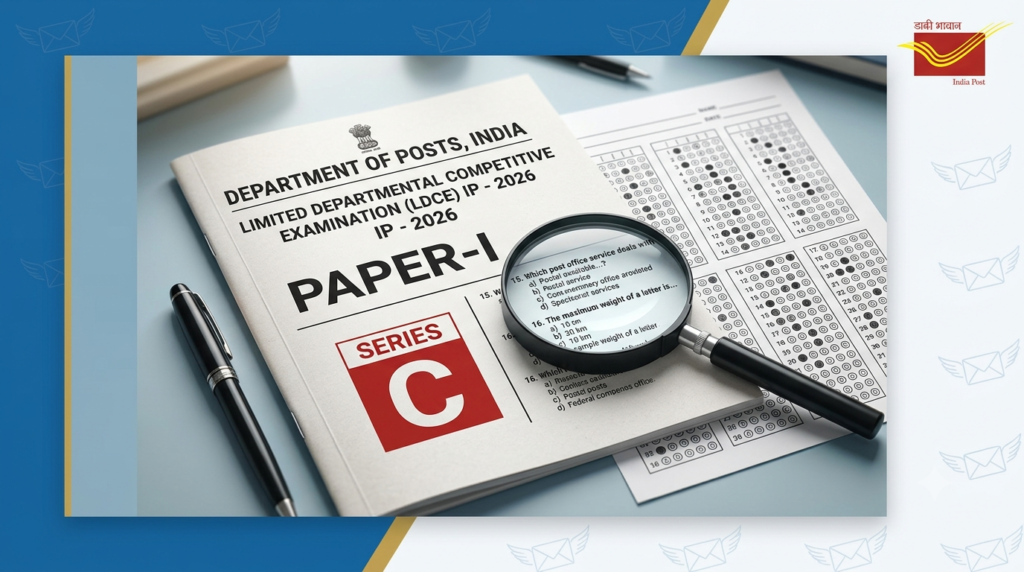
| Featured image alt text | LDCE IP 2026 Paper-I question booklet Series C analysis |
| Category | India Post Previous Year Question Papers |
Tip for SEO: link this post to your LDCE IP 2026 answer key post and your mock test page. Internal links help Google understand your site and keep readers longer, which also improves Google Analytics engagement time.
LDCE IP 2026 Paper-I: A Close Look
The LDCE for Inspector of Posts (IP) 2026 was held on 26 and 27 September 2026. Paper-I is now available, and this post covers the Series C question booklet.
We go through the paper topic by topic, list some important questions with their answers from the provisional answer key, and share what this paper tells us about future exams.
This is useful not only for IP candidates. Many of these topics, like Post Office Act, GDS rules, CCS Conduct Rules and savings schemes, also appear in the MTS to PA, Postman to PA and GDS to MTS departmental exams. So this paper works as great practice material for every India Post Departmental Exam.
Paper at a Glance
| Detail | Information |
|---|---|
| Exam | LDCE for Inspector of Posts (IP) 2026 |
| Paper | Paper-I |
| Booklet series covered here | Series C (other series: A, B, D) |
| Total questions | 125 objective (MCQ) |
| Maximum marks | 250 (2 marks per question) |
| Time allowed | 2 hours 30 minutes |
| Answer mode | OMR sheet, one correct option out of four |
| Language | Bilingual (English and Hindi); English version is final if they differ |
Topic-wise Analysis
The paper covered a wide mix of postal rules, laws and new initiatives. Here are the main areas and the kind of questions asked.
| Topic area | What was asked (examples) |
|---|---|
| Post Office Act 2023, Rules and Regulations 2024 | Rule 16 interception review committee, regulation-making section, posting modes, address standards |
| Postal Manuals (Vol II, V, VII) | Insured bundles, building projects, dismantling sanction, accommodation norms, unpaid article stamps |
| Mail operations and delivery | Postman beat norms, two-wheeler mechanised delivery, Delivery Centres, RTS timelines, due mail list, M-bags |
| Speed Post, parcels and business products | 24 Speed Post, BNPL discounts, contractual parcels, OTP delivery, registration fee, pre-mailing charges |
| International mail and exports | DNK portal, ITPS, Postal Bill of Export, customs duty, Poste Restante demurrage |
| GDS (Conduct and Engagement) Rules 2020 | Definition of GDS, residence rule, age limit, Rule 10 exceptions, appeals, put-off duty |
| CCS Conduct and CCS (CCA) Rules | Rule 18A, Rule 22, family members, workplace, review, minor penalty, inquiry |
| POSB, CBS and insurance | MIS premature closure, RD closure, TD deposits, CBS menus, PLI/RPLI rules, PMJJBY, PMSBY |
| Technology | APT 2.0 (full form, reports, OTP and GPS delivery), DIGIPIN, IPPB accounts |
| Laws | IT Act 2000, PMLA 2002, Consumer Protection Act 2019 |
The biggest share came from postal operations, GDS rules and service rules. The Acts (IT Act, PMLA and CPA) together also carried many marks.
Important Questions with Answers (Provisional Key)
These answers are taken from the provisional answer key released on 29.09.2026. Question numbers are for Series C, with the matching Series A number so readers with other booklets can check too.
| Series C Q. | Series A Q. | Question (in short) | Answer as per provisional key |
|---|---|---|---|
| 3 | 31 | When is an order under Section 68 of CPA 2019 final? | B: If no appeal has been filed under the Act |
| 7 | 32 | Punishment under CPA Section 91 for spurious goods causing grievous hurt | C: Up to 7 years and fine up to ₹5 lakh |
| 8 | 1 | Under PMLA Section 9, confiscated property vests in | A: Central Government |
| 11 | 33 | IT Act Section 2(1)(f): private and public key system is called | B: Asymmetric crypto system |
| 12 | 2 | Adjudicating Authority under PMLA Section 6: Chairperson and how many members | C: Two |
| 15 | 34 | Punishment for cyber terrorism, IT Act Section 66F | B: Imprisonment which may extend to life |
| 16 | 3 | Appeal against Appellate Tribunal order under PMLA Section 42 | D: High Court, within 60 days |
| 17 | 97 | Travel time norm for a two-wheeler beat in a congested area | D: 5 mins/km |
| 20 | 4 | Term defined in PMLA Section 55(a) for a country with a treaty arrangement | A: Contracting State |
| 21 | 98 | Travel workload for 5 km congested + 10 km non-congested two-wheeler beat | B: 55 mins |
| 23 | 36 | IT Act Section 70B establishes | D: CERT-In |
| 24 | 5 | PMLA Section 62 punishment for vexatious search or arrest | A: Up to 2 years or fine up to ₹50,000 or both |
| 36 | 8 | IPPB account opened in self-mode through the app | B: Digi Smart Account |
| 44 | 10 | DIGIPIN developed with IIT Hyderabad and | A: NRSC, ISRO |
| 57 | 107 | Full form of APPU | A: Asian-Pacific Postal Union |
| 60 | 14 | Full form of APT 2.0 | B: Advanced Postal Technology 2.0 |
| 76 | 18 | Rule 18A of CCS Conduct Rules relates to | B: Property outside India and dealings with foreigners |
| 93 | 116 | PMJJBY benefit | C: ₹2 lakh on death due to any cause |
| 97 | 117 | PMSBY age group | D: 18 to 70 years |
| 101 | 118 | PMSBY payout for loss of one eye, hand or foot | A: ₹1 lakh |
How Q21 works: Congested area at 5 mins/km gives 5 × 5 = 25 mins. Non-congested at 3 mins/km gives 10 × 3 = 30 mins. Total = 55 mins.
Note: These are provisional answers. The final key may change after the Department reviews candidate feedback.
Key Observations
- New rules got big focus. Post Office Act 2023, Post Office Rules 2024 and Post Office Regulations 2024 were asked directly. Candidates who studied only the old Indian Post Office Act would have struggled.
- Latest initiatives were tested. DIGIPIN, APT 2.0, DNK (Dak Ghar Niryat Kendra), ITPS, OTP-based delivery and the new delivery centre model all came up.
- Numerical and case-based questions increased. Beat time calculation, BNPL discount, parcel postage and Speed Post tariff questions needed working, not just memory.
- Recent circulars mattered. SB Order 01/2025 and 12/2025, and a CBS ATM charges order dated 30.10.2025, were asked by number.
- Acts stayed important. IT Act, PMLA and Consumer Protection Act questions were mostly section-based and direct.
Overall level: Moderate to tough. Direct rule-based questions were scoring, while tariff and circular-based questions needed up-to-date study.
Preparation Tips for Upcoming Departmental Exams
Whether your next target is IP, MTS to PA, Postman to PA or GDS to MTS, this paper shows what to focus on:
- Read the new laws first. Post Office Act 2023, Rules 2024 and Regulations 2024 are now the base of every postal exam.
- Track circulars every month. SB orders, tariff revisions and new product guidelines are being asked by number and date.
- Practise numericals. Postage, discount slabs and beat norm calculations need regular practice to save time in the exam hall.
- Revise GDS and CCS rules rule-by-rule. Questions often quote a rule number directly.
- Solve previous year papers. Use India Post Previous Year Question Papers to understand the pattern, then test yourself with India Post Mock Tests.
- Keep short notes. One page per Act or rule set makes final revision much faster.
Frequently Asked Questions
Q1. How many questions were in LDCE IP 2026 Paper-I?
Paper-I had 125 objective questions for 250 marks, with 2 hours 30 minutes allowed.
Q2. How can I check answers if my booklet was Series A, B or D?
Use the provisional answer key. It lists the question number for all four series in one row with the correct answer. Our table above also shows Series A numbers.
Q3. Were the questions in both English and Hindi?
Yes. The paper was bilingual, and the English version is treated as final if there is any difference.
Q4. Which topics carried the most weight?
Postal operations, GDS Conduct and Engagement Rules, CCS rules, and the IT Act, PMLA and Consumer Protection Act.
Q5. Is there still time to object to the provisional answer key?
Yes. Feedback can be sent to your Circle’s email ID by 5:30 PM on 6 October 2026, in the Annexure-I format with rule proof.
Q6. Is this paper useful for MTS to PA or Postman to PA exams?
Yes. Topics like Post Office Act 2023, savings schemes, Speed Post and service rules are common across many India Post departmental exams.
Final Words
The LDCE IP 2026 Paper-I clearly rewarded candidates who kept up with new laws, recent circulars and the Department’s latest initiatives. Pure memory of old rules was not enough this time.
If you appeared, check your answers with the key and send feedback before the deadline if you find a mistake. If you are preparing for a future exam, save this paper and practise it under timed conditions.
For more India Post Previous Year Question Papers, India Post Study Material and India Post Latest News, stay connected with us.